
Scope: commercial mining explosives only This Insight is a materials-engineering overview of sensitizer technologies. It intentionally does not provide explosive formulation recipes, field loading instructions, initiation parameters or blast-design guidance. Those activities belong to licensed explosives manufacturers and qualified blasting professionals operating under approved procedures.
Typical density currently listed by 3M for K-15.
Current 3M K-15 isostatic crush-strength listing.
Typical median particle diameter listed by 3M.
Pre-formed gas-filled voids: a physical sensitization route.
01 WHY THE SENSITIZER MATTERS
Published 3M mining literature frames the sensitizer as a major contributor to the effectiveness of a commercial explosive charge because it creates internal voids that support detonation. The brochure further links stable sensitization with repeatability over time, temperature and pressure, as well as with consistent distribution and longer sleep-time stability.
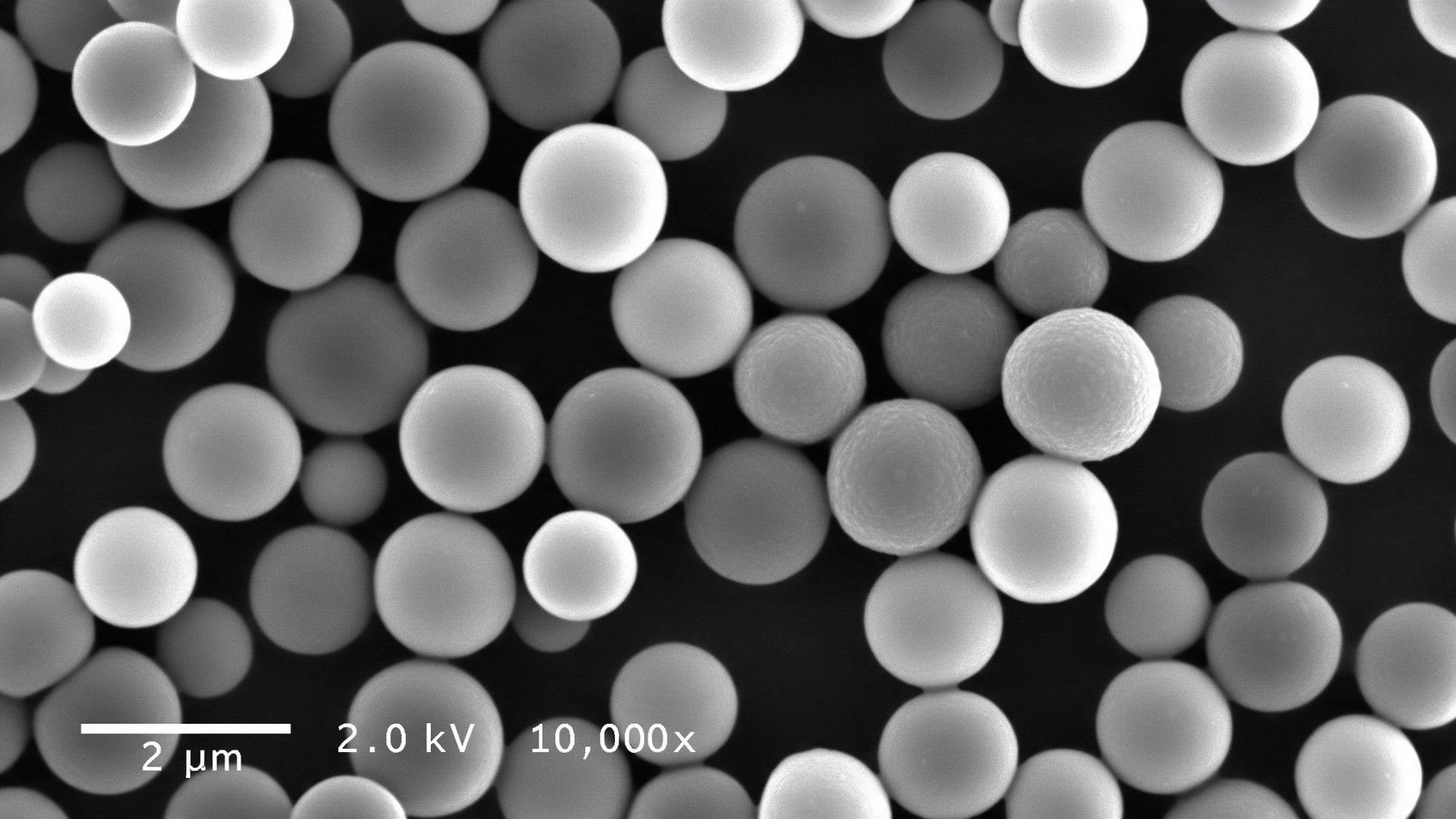
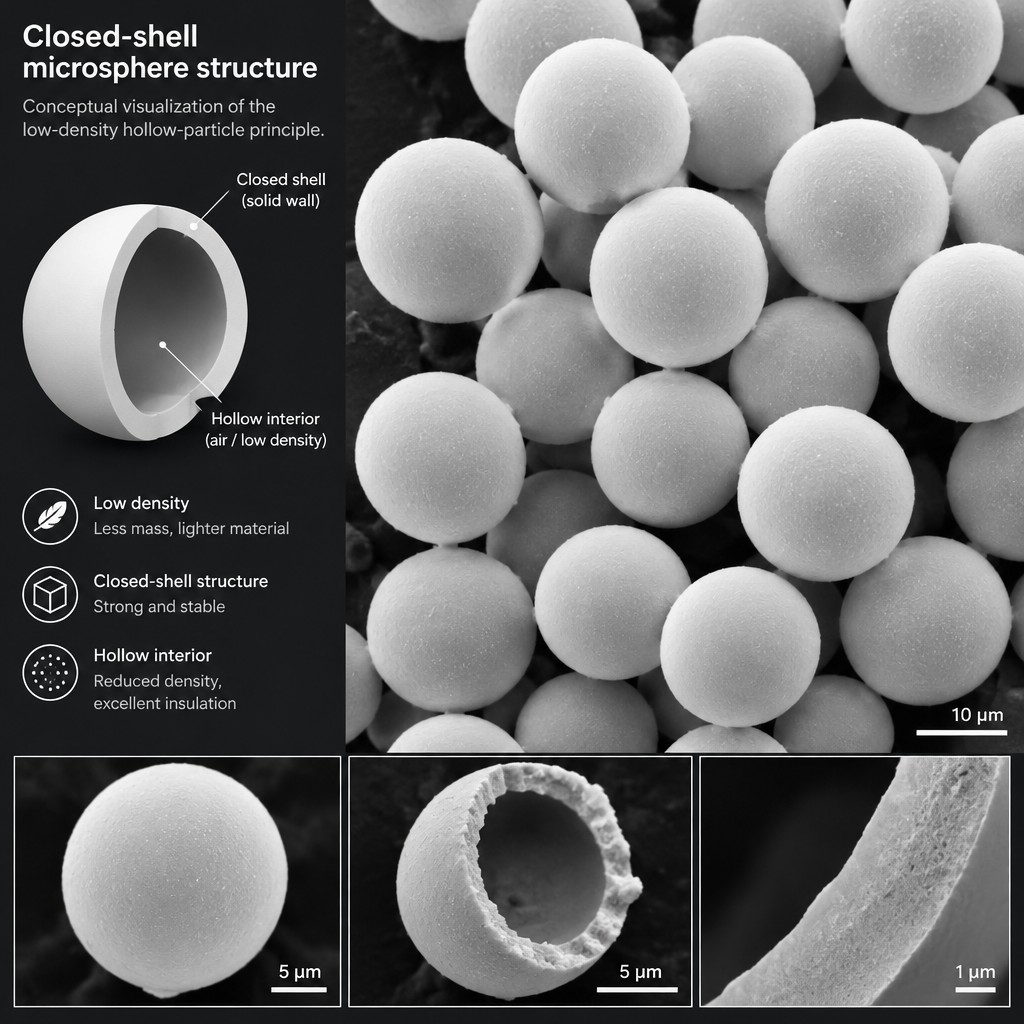
Controlled spherical geometry. A manufactured microsphere population is fundamentally different from an irregular porous mineral: the void shape is discrete, closed-shell and intentionally engineered. Image: Geocon conceptual microsphere visual.
THE SENSITIZER IS NOT JUST “LOW DENSITY.”
For mining explosives, the engineering question is whether low-density voids remain sufficiently small, distributed and stable during handling, pressure exposure and the required sleep time.
02 K-15 — LOW DENSITY WITH A DEFINED SHELL STRENGTH
3M’s current K-15 product information lists K-15 as a soda-lime borosilicate hollow glass sphere with typical density of 0.15 g/cc, isostatic crush strength of 300 psi and typical median particle diameter of 60 µm. 3M also identifies emulsion explosives among the product’s typical applications.
| K-15 attribute | Published value / description | Mining sensitization relevance |
|---|---|---|
| Composition | Soda-lime borosilicate glass | Chemically stable, non-porous shell material |
| Typical density | 0.15 g/cc | Low-density void carrier |
| Isostatic crush strength | 300 psi | Indicates ability of the shell population to survive compressive stress |
| Typical median diameter | 60 µm | Controls void scale and dispersion characteristics |
| Geometry | Hollow sphere | Discrete, repeatable void shape compared with irregular porous sensitizers |
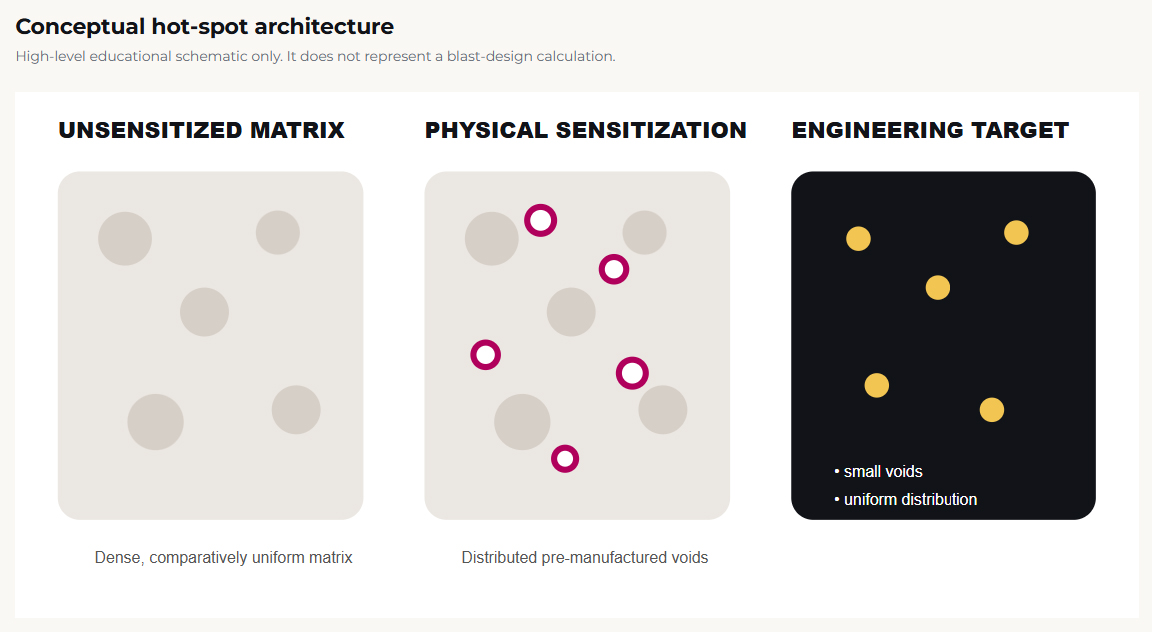
03 HOT-SPOT SCIENCE — WHY A STABLE VOID MATTERS
3M’s mining brochure describes the sensitization requirement in terms of density discontinuities or “hot spots.” It notes two high-level mechanisms discussed in the literature—adiabatic compression and jet-type energy transfer—but the practical materials requirement is simpler: the void population should be small, low in density, homogeneously distributed and stable over time, temperature and pressure.
04 K-15 VS PERLITE VS GAS SENSITIZATION
These three approaches all create density discontinuities, but they do so in fundamentally different ways. Glass microspheres and expanded perlite are physical sensitizers; gas sensitization creates voids in situ. A 2022 tutorial review notes that glass microspheres are widely used for physical sensitization and that perlite is also used, although its use has been declining. Published work on chemically generated gas sensitization highlights the importance of temperature- and time-dependent reaction kinetics and density stability.
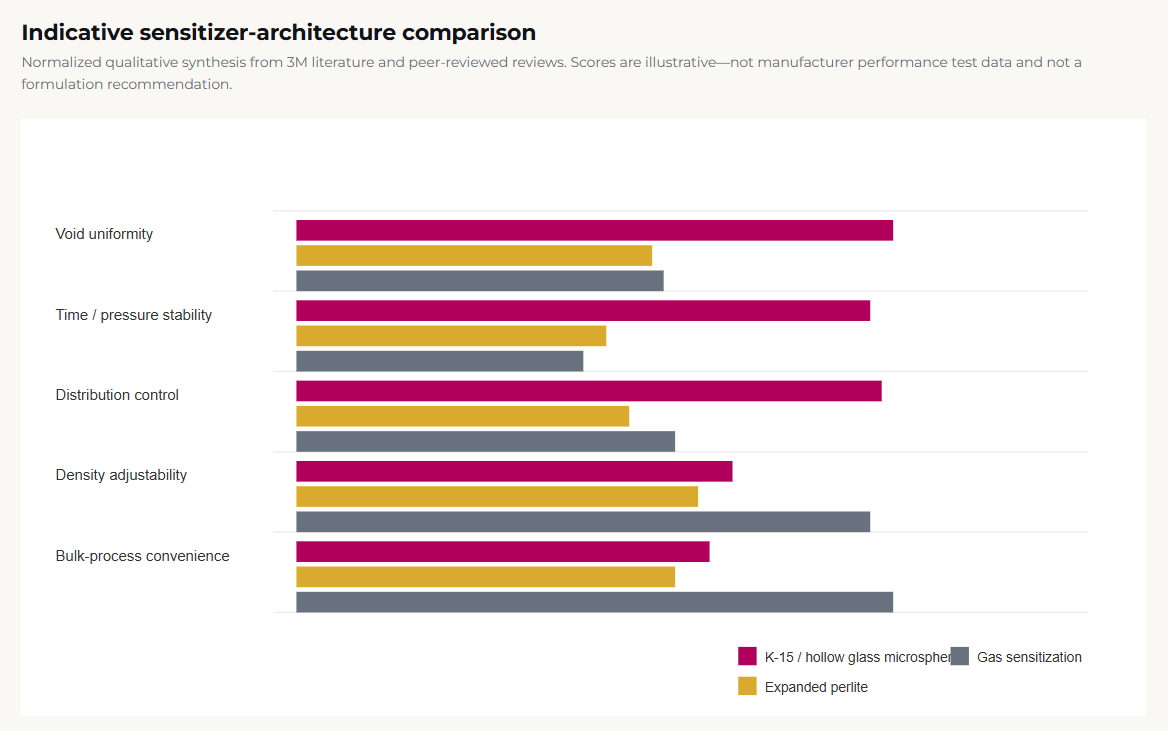
PRE-MANUFACTURED VOID
Strongest conceptual advantage: repeatable sphere geometry, discrete distribution and a defined shell-strength specification.
POROUS MINERAL VOID
Physical sensitizer with irregular porous morphology. It can be economical, but particle shape and compressive behavior differ from a manufactured hollow sphere.
IN-SITU VOID GENERATION
Creates gas bubbles during processing. It can offer strong density adjustability, while published reviews emphasize the importance of reaction kinetics, time and temperature control.
05 SELECTION LOGIC — CONSISTENCY FIRST
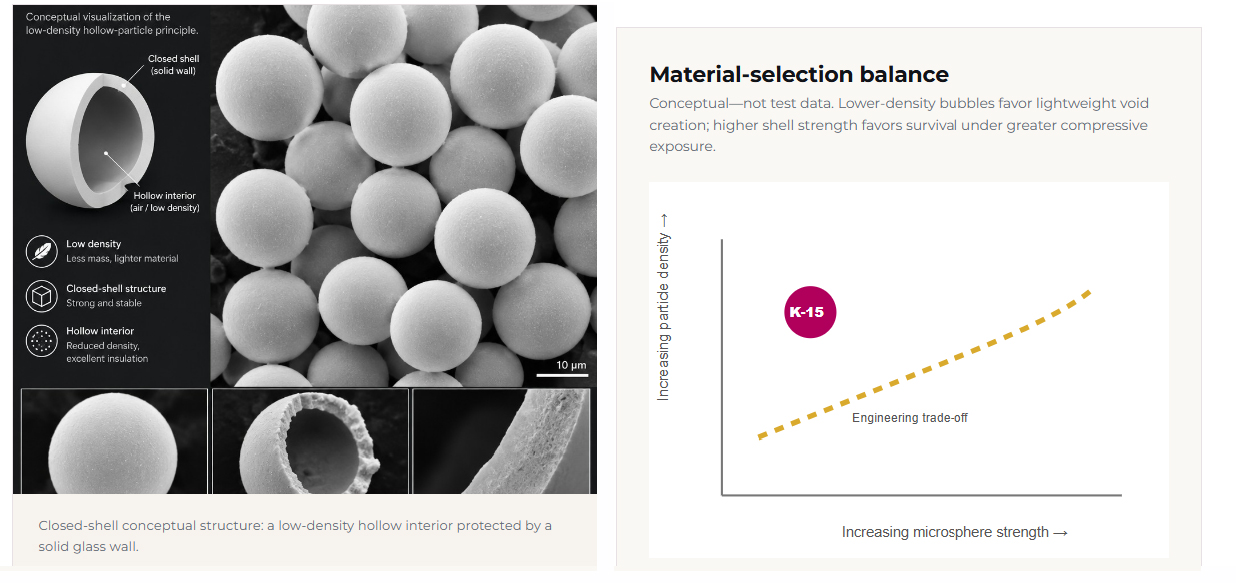
3M’s mining literature differentiates sensitizer choice according to the stress environment. For bulk emulsion systems it notes that extremely high-strength bubbles may not be necessary, while packaged applications can place greater emphasis on resistance to shock or dead pressing. K-15 appears in both categories in the brochure, which helps explain its role as a low-density, general-purpose sensitizer candidate.
| Engineering question | Why it matters | Material-selection implication |
|---|---|---|
| How stable must the void population remain? | Sleep time, pressure and handling can alter sensitizer integrity | Prefer a void architecture with adequate stability for the intended service window |
| How uniform is the sensitizer distribution? | Hot-spot uniformity supports repeatable detonation behavior | Manufactured discrete spheres can offer strong distribution control |
| What pressure/shock environment will the product see? | Excess stress can destroy sensitizing voids | Match bubble strength to the validated application envelope |
| How important is density adjustment during processing? | Different sensitization routes provide different process flexibility | Gas generation can offer adjustability; pre-formed solids offer a more fixed void architecture |
| How consistent must the product be lot-to-lot? | Mining economics depend on repeatable blast outcomes | Controlled manufactured particles can simplify one part of the variability picture |
Selection is not substitution.
Changing from gas sensitization or perlite to glass microspheres changes the void-generation mechanism and should be treated as a full commercial-explosive reformulation and qualification program by a licensed manufacturer—not as a one-for-one ingredient swap.
06 WHAT A MINE-SIDE TECHNICAL PROGRAM SHOULD VALIDATE
A responsible evaluation should connect sensitizer-material properties to the performance of the finished commercial explosive system. The objective is not simply to reach a target density, but to maintain repeatability through storage, pumping or packaging, borehole conditions and the required sleep time.
| Validation area | High-level question |
|---|---|
| Density consistency | Does the finished product remain within the manufacturer’s approved density window over the intended service period? |
| Void survival | Does handling, pressure or packaging materially damage the sensitizer population? |
| Distribution | Is the sensitizer uniformly dispersed without segregation or local concentration? |
| Sleep-time stability | Does sensitization remain sufficiently stable between loading and firing? |
| Detonation consistency | Does the qualified system deliver repeatable VOD and fragmentation under the intended mine conditions? |
| Economics | Does the sensitizer improve the overall cost per tonne of rock moved after considering product cost, fragmentation, secondary breaking and process reliability? |
07 TECHNICAL FAQ
Technical references used for this Insight
- 3M — Glass Bubbles for Explosive Formulations / Mining brochure.
- 3M — Current K-15 product information.
- Materials (2022) — Emulsion Explosives: A Tutorial Review and Highlight of Recent Progress.
- Applied Sciences — Review of sensitizer influence on emulsion explosive properties.
Third-party copyright / trademark notice: 3M™ and 3M Glass Bubbles™ are trademarks of 3M Company. Geocon Products does not claim ownership of 3M trademarks. Third-party technical literature is cited for identification, attribution and educational discussion only. This article uses independent wording and Geocon-created graphs/diagrams rather than reproducing 3M brochure artwork. Product suitability and commercial explosive design remain the responsibility of the qualified explosive manufacturer and licensed blasting professionals.
SELECT THE VOID ARCHITECTURE-THEN VALIDATE THE SYSTEM.
For material-selection discussions around 3M Glass Bubbles K-15 and other hollow glass microsphere grades, Geocon can support product-property comparison and application screening. Commercial explosive formulation and blast-design decisions must remain within the approved procedures of qualified explosives professionals.