

Easy Clean Coating
EZC 1000
Reactive fluorosilane treatment for ultra-thin, low-surface-energy protection on glass, ceramics and sanitaryware - delivering water repellency, oil repellency and easier cleaning.
A molecular shield against water, oil and stains.
EZC 1000 reacts with siliceous and silicate surfaces to create an ultra-thin, low-surface-energy layer. Liquids do not easily wet the treated surface, allowing soils, soap residue and hard-water deposits to release more readily during cleaning.
The treatment is normally applied at OEM level by fine spray or dip coating. At the recommended add-on, it maintains the original appearance while adding hydrophobicity, oleophobicity and enhanced surface lubricity.
Easy-clean, not self-cleaning.
The surface still requires maintenance, but deposits adhere less strongly, aggressive cleaners may be reduced, and the time between cleaning cycles can be extended.
Clean the Surface
Remove dust, oil and contamination using suitable detergent, acetone or ethanol.
Prepare Treatment
Dilute EZC 1000 in the specified alcohol, water and acetic-acid system.
Anchor to Surface
The reactive treatment forms a durable low-energy layer on the siliceous substrate.
Reduce Wetting
Water, oil and soils have less affinity for the treated surface and release more easily.
Water Repellency
Creates a hydrophobic surface with initial water contact angles of 90°-105°.
Oil Repellency
Initial hexadecane contact angles of 55°-65° demonstrate oleophobic behaviour.
Stain Resistance
Helps resist soap scum, fingerprints, oils, sludge and hard-water deposits.
Easy Cleaning
Soils tend to release during rinsing, reducing dependence on aggressive cleaners.
Durable Treatment
Contact-angle retention is documented after cleaner abrasion and acid exposure.
Original Appearance
The nanometre-scale layer is designed not to visibly change the treated surface.
Water Contact-Angle Retention
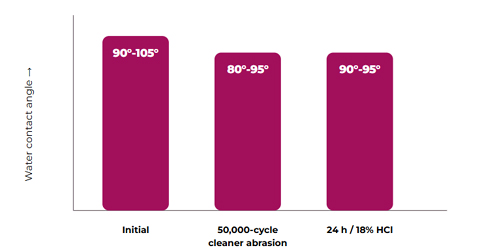
Bar heights are visual; printed ranges are authoritative. Tests and substrates are defined in the source methods.
Low-Energy Surface Concept
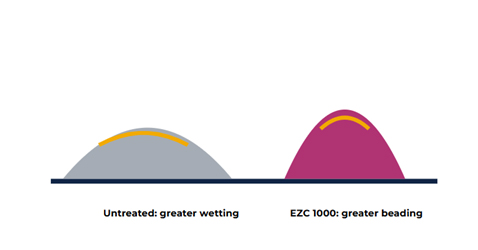
Conceptual illustration. Contact angle varies with substrate, preparation, liquid and temperature.
One treatment. Multiple premium surfaces.
Select a substrate to see recommended positioning.
Architectural & Shower Glass
Applications
- Shower doors and cabins
- Decorative glass panels
- Fingerprints and oil-mark reduction
- Hard-water-deposit release
Ceramic & Glazed Surfaces
Applications
- Glazed tiles
- Ceramic wall panels
- Siliceous decorative surfaces
- OEM easy-clean finishes
Sanitaryware Protection
Applications
- Wash basins and sinks
- Toilets and urinals
- Shower trays and tubs
- Inside-and-outside fixture treatment
Crosslinking with Hybrid Coatings
EZC 1000 Positioning
EZC 1000 may be evaluated as a reactive fluorosilane component in silane, sol-gel and organic-inorganic hybrid systems to combine substrate anchoring with low-surface-energy functionality.
- Silane-modified clear coats
- Sol-gel easy-clean layers
- Hybrid ceramic coatings
- Crosslinked protective topcoats
solution.
Approx. 0.1 wt% product in the final working solution.
Working life: approximately 4-6 hours.
Source Reference Formula
- 954 g ethanol containing less than 0.1% water
- Add 30 g water
- Add 15 g acetic acid
- Add 1 g EZC 1000
- Mix well to obtain a slightly hazy solution
90-110°C
Bring the clean part to the stated application temperature.
Fine Mist at 2 bar
Maintain approximately 10-20 cm between spray gun and substrate.
50-75 mL/m²
Apply uniformly without exceeding the recommended add-on.
Cool to 40-50°C
Gently remove excess before complete cooling; final performance may take 48 hours.
| PROPERTY | TYPICAL VALUE | NOTES |
|---|---|---|
| Product | EZC 1000 | Reactive fluorosilane easy-clean treatment |
| Appearance | Slightly viscous, slightly yellow liquid | Concentrated treatment |
| Specific Gravity | 1.6 kg/L | At stated source conditions |
| Flash Point | None | Concentrated product; consider solvents in working solution |
| Type | Nonionic | Source classification |
| Composition | 100% active treatment | As supplied |
| Initial Contact Angle | Water 90°-105° / Hexadecane 55°-65° | Typical performance data |
| After 50,000 Cleaner-Abrasion Cycles | Water 80°-95° / Hexadecane 45°-50° | Source test system |
| After 40 Cycles with Cif Cleaner | Water 70°-80° / Hexadecane 40°-45° | Source test system |
| After 24 h in 18% HCl at 20°C | Water 90°-95° / Hexadecane 50°-55° | Source exposure method |
| Storage | 10-25°C; closed, cool, dry and away from sunlight | Avoid moisture contact |
| Shelf Life | 1.5 years from manufacture | In recommended storage conditions |
Crosslink repellency into a functional coating.
For hybrid systems, treat EZC 1000 as a reactive formulation component rather than a simple slip additive. Its interaction with silanol-rich binders, sol-gel networks, inorganic surfaces and cure catalysts should be evaluated through a structured ladder.
Monitor pot life, haze, adhesion, cure, contact angle and abrasion retention. Addition sequence and water level can strongly influence hydrolysis, condensation and final surface migration.
Suggested validation:
Untreated control → low EZC 1000 level → medium level → high level. Compare clarity, wetting, crosslinking, adhesion, water/oil contact angle, stain release and durability.
Quick Technical
Answers
Place the approved PDFs beside this HTML file using the filenames assigned below.
Need Our Services?
Call: +91 97695 93030
Work Hours
Mon – Sat: 9:00 AM – 6:00 PM IST
Email Us
support@geoconproducts.com