

fluorosurfactant
NON IONIC
S-386
100% active fluorosurfactant engineered for powerful surface-tension reduction, rapid substrate wetting and improved levelling across water-based, solvent-based and high-solids industrial formulations.
Wetting power beyond conventional surfactants.
S-386 is a concentrated nonionic fluorosurfactant capable of reducing equilibrium surface tension below 20 mN/m in the documented phosphate-buffer test system. This strong surface activity helps liquid formulations wet low-energy, contaminated, porous and geometrically complex surfaces at very low addition levels.
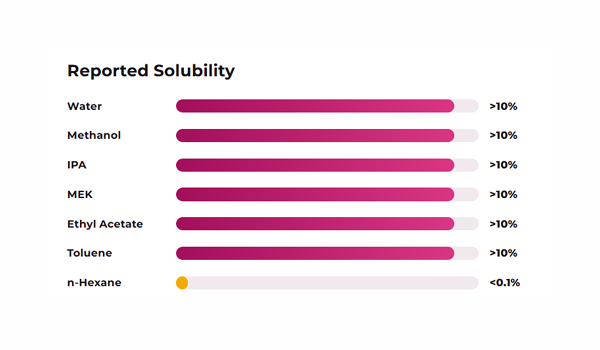
Its broad solubility in water and commonly used polar and aromatic solvents enables evaluation across coatings, inks, construction chemicals, electronics, textiles, metal-treatment baths and industrial finishing systems.
One additive. Seven application platforms.
Use S-386 where a formulation must spread faster, cover difficult areas, reduce surface defects or improve liquid contact with the substrate.
Introduce at Low Level
Pre-dilute where helpful and incorporate into the liquid phase under controlled mixing.
Move to the Interface
Surface-active molecules rapidly orient at liquid-air and liquid-solid boundaries.
Reduce Surface Tension
The formulation gains the ability to contact difficult low-energy surfaces.
Improve Wetting
Faster and more uniform spread supports coverage, levelling and penetration.
Super Wetting
Promotes rapid contact on low-energy, porous, dusty or difficult-to-wet substrates.
Improved Levelling
Supports smoother flow and more uniform film formation in compatible systems.
Defect Reduction
May help minimise craters, crawling, poor edge coverage and incomplete wet-out.
Penetration
Improves liquid access into fibres, pores, micro-features and complex geometries.
Broad Solubility
Reported above 10% in water, alcohols, ketone, acetate and aromatic solvent.
Nonionic Compatibility
Provides a practical starting route across formulations containing different ionic components.
Surface Tension vs Concentration
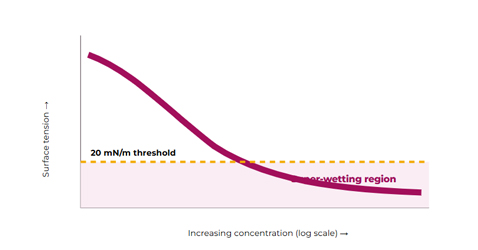
Qualitative recreation of the supplied S-386 graph at pH 6.86; consult the approved TDS for the source curve.
Contact-Angle Concept
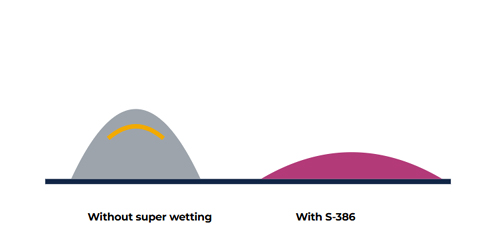
Conceptual illustration. Actual contact angle depends on the complete formulation and substrate.
Explore S-386 by industry.
Select an application platform to view target uses and formulation objectives.
Wetting and levelling across demanding substrates
Evaluate in water-based, solvent-based, high-solids and compatible radiation-curable systems.
Target Uses
- Architectural and industrial coatings
- Automotive and refinish coatings
- Wood and plastic coatings
- Epoxy and polyurethane floors
- Powder-coating post-add evaluation
- Primer and topcoat wetting
- Edge and recess coverage
- Anti-crater optimisation
Faster wetting on films, foils and difficult media
Supports substrate wetting, flow and print uniformity while preserving pigment-dispersion stability.
Target Uses
- Flexographic inks
- Gravure inks
- Screen-printing inks
- Inkjet formulation development
- Packaging films and foils
- Overprint varnishes
- High-speed printing
- Pinholing and crawling control
Rapid wetting of mineral and porous surfaces
Useful where a liquid treatment must spread across cementitious, stone, ceramic or dusty substrates.
Target Uses
- Epoxy and PU flooring
- Stone and tile treatments
- Waterproofing coatings
- Concrete primers
- Repair mortars and grouts
- Protective sealers
- Water-repellent treatments
- Hybrid silane systems
Wet complex circuit surfaces and fine features
Screen carefully for residues, ionic cleanliness, dielectric behaviour and long-term reliability.
Target Uses
- Solder paste and no-clean flux
- Liquid flux systems
- Conformal coatings
- Electronic cleaners
- Encapsulants and resins
- Fine-pitch BGA/QFN assemblies
- PTFE dispersion support
- Selective coating processes
Improve fibre wet-out and bath penetration
Evaluate at low level in processing baths and finishes, including foam behaviour and wash durability.
Target Uses
- Fibre and fabric wetting
- Dye-bath penetration
- Coating and lamination
- Water- and oil-repellent finishes
- Print-paste wetting
- Nonwoven treatments
- Technical textiles
- Uniform finish application
Reach recessed, oily and high-energy metal surfaces
Use to improve bath contact and drainage while checking compatibility with cleaners, acids and salts.
Target Uses
- Alkaline and solvent cleaners
- Acid pickling baths
- Conversion coatings
- Phosphating pretreatment
- Electroplating auxiliaries
- Flux and soldering treatments
- Degreasing systems
- Complex-part wetting
Promote uniform coverage and clean surface appearance
Suitable for evaluation in dip, spray, roll, wipe and flow-coating operations.
Target Uses
- Glass and ceramic finishing
- Plastic surface treatments
- Leather and synthetic finishing
- Polishes and protective finishes
- Release and anti-soiling systems
- Decorative topcoats
- Precision-part finishing
- Low-add-on surface treatments
Practical incorporation:
S-386 can be pre-diluted for easier metering and distribution. Select a compatible component already present in the formulation wherever possible.
Compatibility check: High solubility in a neat medium does not guarantee stability in a complete formulation containing resin, pigments, electrolytes, defoamers and other surface-active additives.
Active additive on total formulation for general coating and surface-treatment evaluation.
Formulation trial sequence
- Prepare an untreated control.
- Screen S-386 at 0.05%, 0.10% and 0.15% active.
- Measure surface tension, contact angle, wetting and levelling.
- Check foam, intercoat adhesion, recoatability and film defects.
- Verify cure, gloss, printability, water resistance or process-specific performance.
- Select the lowest level that achieves the required result.
| PROPERTY | CONFIRMED VALUE | FORMULATION RELEVANCE |
|---|---|---|
| Product | S-386 | Specialty fluorosurfactant |
| Appearance | Light-yellow viscous liquid | Concentrated liquid additive |
| Ionicity | Nonionic | Useful starting route across different ionic systems |
| Composition | 100 wt% | No carrier dilution stated |
| Surface Tension | Below 20 mN/m achievable | Super-wetting performance |
| Surface-Tension Test | pH 6.86 phosphate buffer | Reference condition for supplied curve |
| Solubility Above 10% | Water, methanol, IPA, MEK, ethyl acetate, toluene | Broad medium selection |
| Solubility Below 0.1% | n-Hexane | Limited aliphatic-hydrocarbon solubility |
| General Starting Screen | 0.05-0.15% active | Optimise for each formulation |
Quick Technical
Answers
Place approved PDF documents beside this HTML file using the filenames assigned below.
Need Our Services?
Call: +91 97695 93030
Work Hours
Mon – Sat: 9:00 AM – 6:00 PM IST
Email Us
support@geoconproducts.com