
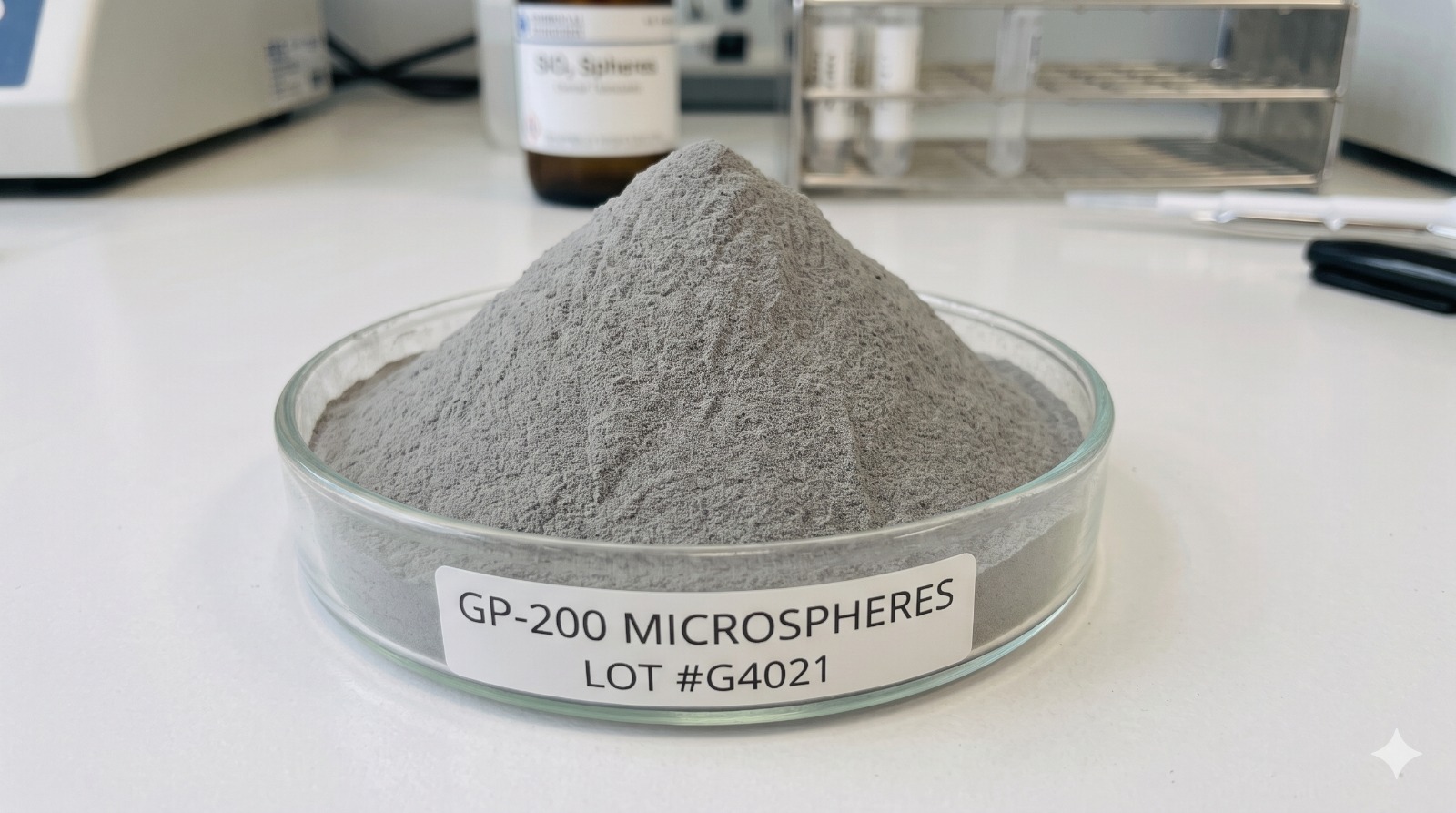
GP-200 Grey
Ceramic Microspheres
A dense, high-strength alumino-silicate ceramic filler engineered for mechanical integrity, dimensional stability and abrasion resistance in demanding industrial formulations.
Fine ceramic reinforcement for severe service
The combination of 7 µm median particle size, spherical morphology and dense ceramic structure supports efficient packing, high film build and mechanical durability.
60,000 psi Crush Strength
High structural integrity for load-bearing, high-pressure and heavy-duty systems.
Mohs Hardness 6–7
Hard ceramic reinforcement improves resistance to abrasion and mechanical wear.
Efficient Film Packing
A fine 7 µm D50 supports smooth surfaces and high-solids formulations.
Scrub, Burnish & Abrasion Resistance
Hard ceramic spheres help coatings resist repeated cleaning, polishing marks and surface wear.
Thermal & Chemical Resistance
Stable above 1,000°C and resistant to acids, alkalis and hydrocarbons.
Dimensional Stability
The rigid structure helps minimise shrinkage, cracking and deformation.
Built for mechanically demanding applications
GP-200 is preferred where strength, wear resistance and dimensional stability matter more than aesthetic whiteness.
What is scrub and burnish resistance?
A coating must survive repeated cleaning without wearing away—and preserve its original sheen without developing polished, glossy patches.
Scrub Resistance
The ability of a dried coating film to withstand repeated wet cleaning with water, detergent, brushes or sponges without erosion, scratching, loss of hiding or exposure of the substrate.
Burnish Resistance
The ability of a coating—especially a matt or low-sheen finish—to resist an unwanted increase in gloss caused by rubbing, cleaning or polishing.
How GP-200 helps the coating film
Hard Ceramic Reinforcement
Mohs hardness of 6–7 helps the film resist cleaning abrasion, scratches and surface wear.
High Structural Strength
Individual spheres withstand 60,000 psi, helping them remain intact during processing and service.
Efficient Film Packing
A fine 7 µm D50 and spherical morphology promote uniform packing, film build and a smoother surface.
Dense Ceramic Structure
The high-strength structure reinforces protective films exposed to repeated impact and wear.
Practical result: GP-200 can support a harder, smoother and more uniformly packed coating film that better withstands repeated cleaning while retaining a consistent matt or low-sheen appearance. Final performance depends on resin quality, pigment-volume concentration, formulation balance and application conditions, so the optimum addition level should be established through laboratory trials.
Strength designed into every sphere
The dense ceramic structure combines fine particle size with high crush strength and temperature resistance.
Key Performance Indicators
Relative display of published GP-200 values
Bars visualise distinct properties and are not a common-unit quantitative comparison.
GP-200 Technical Profile
Published product-page values
Particle & Density
- D50: 7 µm
- True density: 2.6–2.8 g/cc
- Bulk density: 1.3–1.6 g/cc
- Spherical morphology
Strength & Stability
- Crush strength: 60,000 psi
- Mohs hardness: 6–7
- Thermal stability: >1,000°C
- Dense, high-strength structure
Typical values; use the current CoA for lot-specific results.
Designed for
practical processing
Introduce GP-200 under suitable agitation and optimise the loading according to viscosity, finish and mechanical requirements.
Pre-check compatibility
Confirm wetting and dispersion in the selected resin or binder system.
Add under controlled mixing
Use sufficient agitation for uniform incorporation without unnecessary dusting.
Optimise by trial
Evaluate viscosity, density, finish, adhesion and mechanical properties.
GP-200 can be used as a partial functional replacement for conventional fillers. The optimum replacement level should be established by laboratory trials.
| Parameter | Typical Value |
|---|---|
| Chemical Composition | Alumino-silicate ceramic |
| Colour | Grey — light to dark |
| Particle Morphology | Spherical |
| Structure | Dense / high-strength |
| Median Particle Size — D50 | 7 µm |
| True Density | Approximately 2.6–2.8 g/cc |
| Bulk Density | Approximately 1.3–1.6 g/cc |
| Crush Strength | 60,000 psi |
| Mohs Hardness | Approximately 6–7 |
| pH — Slurry | Neutral to mildly alkaline |
| Thermal Stability | >1,000°C |
| Form | Free-flowing powder |
| CAS Number | 93924-19-7 |
| EINECS Number | 300-212-6 |
| Packaging | 25 kg HDPE-lined paper bags; bulk bags on request |
Need Our Services?
Call: +91 97695 93030
Work Hours
Mon – Sat: 9:00 AM – 6:00 PM IST
Email Us
support@geoconproducts.com