
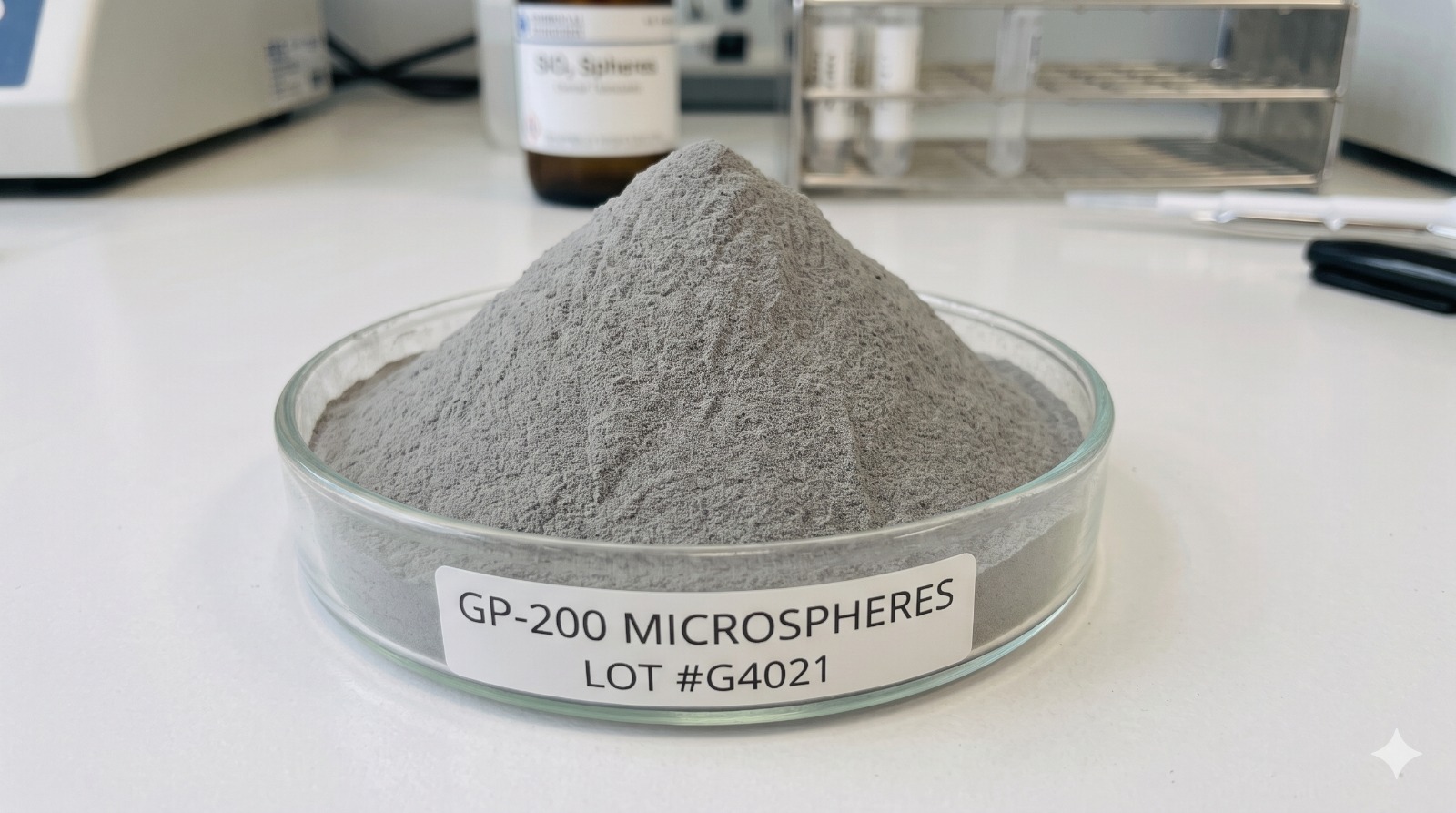
GP-400 Grey
Ceramic Microspheres
A high-strength alumino-silicate ceramic filler engineered to balance mechanical reinforcement, controlled particle size and optimised rheology in demanding industrial formulations.
Balanced reinforcement, flow and film build
Its medium-fine particle distribution bridges fine reinforcement and medium-volume loading for coatings, adhesives, cementitious systems and composites.
Medium-Fine Distribution
Approximately 8 µm D50, 18 µm D90 and 23 µm D95 support controlled surface texture and build.
Mohs Hardness 6–7
Hard ceramic reinforcement improves abrasion resistance and mechanical durability.
Optimised Rheology
Spherical morphology supports flow and controlled viscosity in higher-solids formulations.
High-Build Capability
Designed for thicker coating films, flooring systems, tile adhesives and repair mortars.
Thermal & Chemical Resistance
Stable above 1,000°C and suitable for demanding industrial environments.
Dimensional Stability
The rigid ceramic structure helps minimise shrinkage, cracking and deformation.
Versatile performance across high-build systems
GP-400 balances processing ease and mechanical performance in industrial formulations where a slightly broader distribution improves build or interlocking.
GP-400 or GP-200—which particle profile fits?
Both are dense, high-strength grey ceramic microspheres. The key distinction is particle-size distribution and the resulting balance between surface smoothness, coating build and processing behaviour.
Choose GP-400
For higher-build coatings, tile adhesives, construction chemicals and systems where a slightly broader particle distribution supports flow, build efficiency or mechanical interlocking.
Choose GP-200
For thin-film coatings, smoother finishes and fine-filler applications where the 7 µm D50 is preferred to minimise surface roughness.
How GP-400 supports higher-build formulations
Particle Profile
D50: approximately 8 µm
D90: approximately 18 µm
D95: approximately 23 µm
Shape: spherical
Structure: dense and high-strength
Formulation Profile
True density: approximately 2.4 g/cc
Oil absorption: approximately 26 g/100 g
Hardness: Mohs 6–7
Surface area: approximately 5 m²/cc
Thermal stability: above 1,000°C
Controlled Rheology
Spherical morphology improves flow in epoxy, polyurethane and acrylic coating systems.
High-Build Efficiency
The medium-fine distribution supports rapid thickness build without excessive viscosity increase.
Mechanical Interlocking
A broader distribution than GP-200 suits tile adhesives, mortars and higher-build systems.
Uniform Packing
Spherical particles help reduce segregation and improve consistency in filled formulations.
Formulation advantage: GP-400 is a versatile bridge grade for formulators who need more
build and processing latitude than a very fine microsphere while
retaining ceramic hardness, dimensional stability and spherical-particle
flow.
Final performance depends on the resin or cement system, loading,
dispersant package, application method and curing conditions. Confirm
the optimum addition level through laboratory trials.
A medium-fine distribution for practical build
The particle-size curve and spherical morphology are designed to balance surface quality, packing and higher-build processing.
Particle-Size Distribution
Published typical values
Bar lengths directly represent the published particle-size values on a common 23 µm scale.
GP-400 Technical Profile
Published product-page values
Particle & Density
- D50: ~8 µm
- D90: ~18 µm
- D95: ~23 µm
- True density: ~2.4 g/cc
Surface & Stability
- Oil absorption:~26 g/100g
- Surface area:~5 m²/cc
- Mohs hardness:6–7
- Thermal stability:>1,000°C
Typical values; use the current CoA for lot-specific results.
Designed for
practical processing
Introduce GP-400 under suitable agitation and optimise the loading according to viscosity, finish and mechanical requirements.
Pre-check compatibility
Confirm wetting and dispersion in the selected resin or binder system.
Add under controlled mixing
Use sufficient agitation for uniform incorporation without unnecessary dusting.
Optimise by trial
Evaluate viscosity, density, finish, adhesion and mechanical properties.
GP-400 can be used as a partial functional replacement for conventional fillers. The optimum replacement level should be established by laboratory trials.
| Parameter | Typical Value |
|---|---|
| Chemical Composition | Alumino-silicate ceramic |
| Colour | Grey |
| Particle Morphology | Spherical |
| Structure | Dense / high-strength |
| True Density | Approximately 2.4 g/cc |
| Particle Size — D50 | Approximately 8 µm |
| Particle Size — D90 | Approximately 18 µm |
| Particle Size — D95 | Approximately 23 µm |
| Surface Area | Approximately 5 m²/cc |
| Oil Absorption | Approximately 26 g/100 g |
| Mohs Hardness | Approximately 6–7 |
| Thermal Stability | >1,000°C |
| Form | Free-flowing powder |
| CAS Number | 93924-19-7 |
| EINECS Number | 300-212-6 |
| Packaging | 25 kg HDPE-lined paper bags; bulk bags on request |
Need Our Services?
Call: +91 97695 93030
Work Hours
Mon – Sat: 9:00 AM – 6:00 PM IST
Email Us
support@geoconproducts.com