

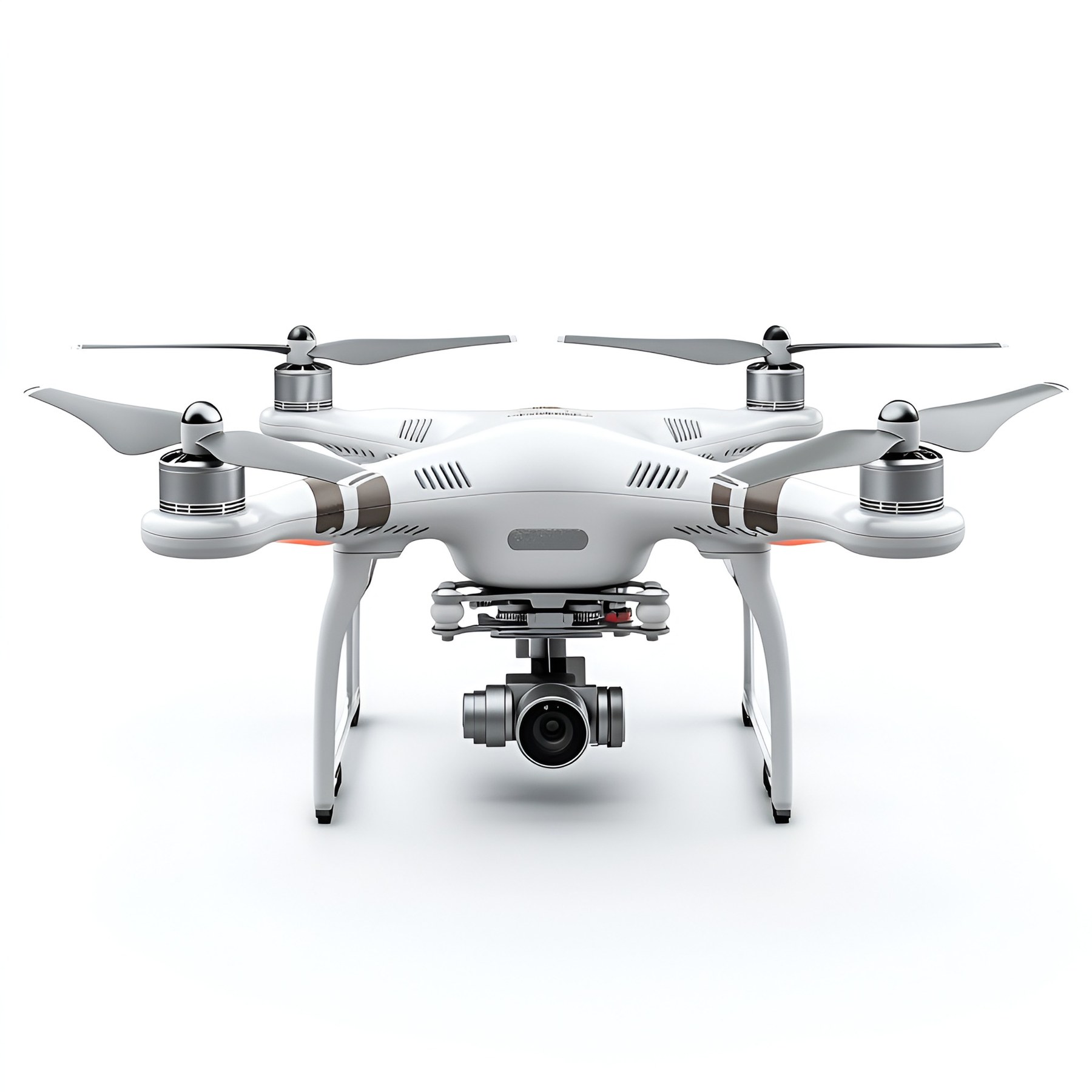
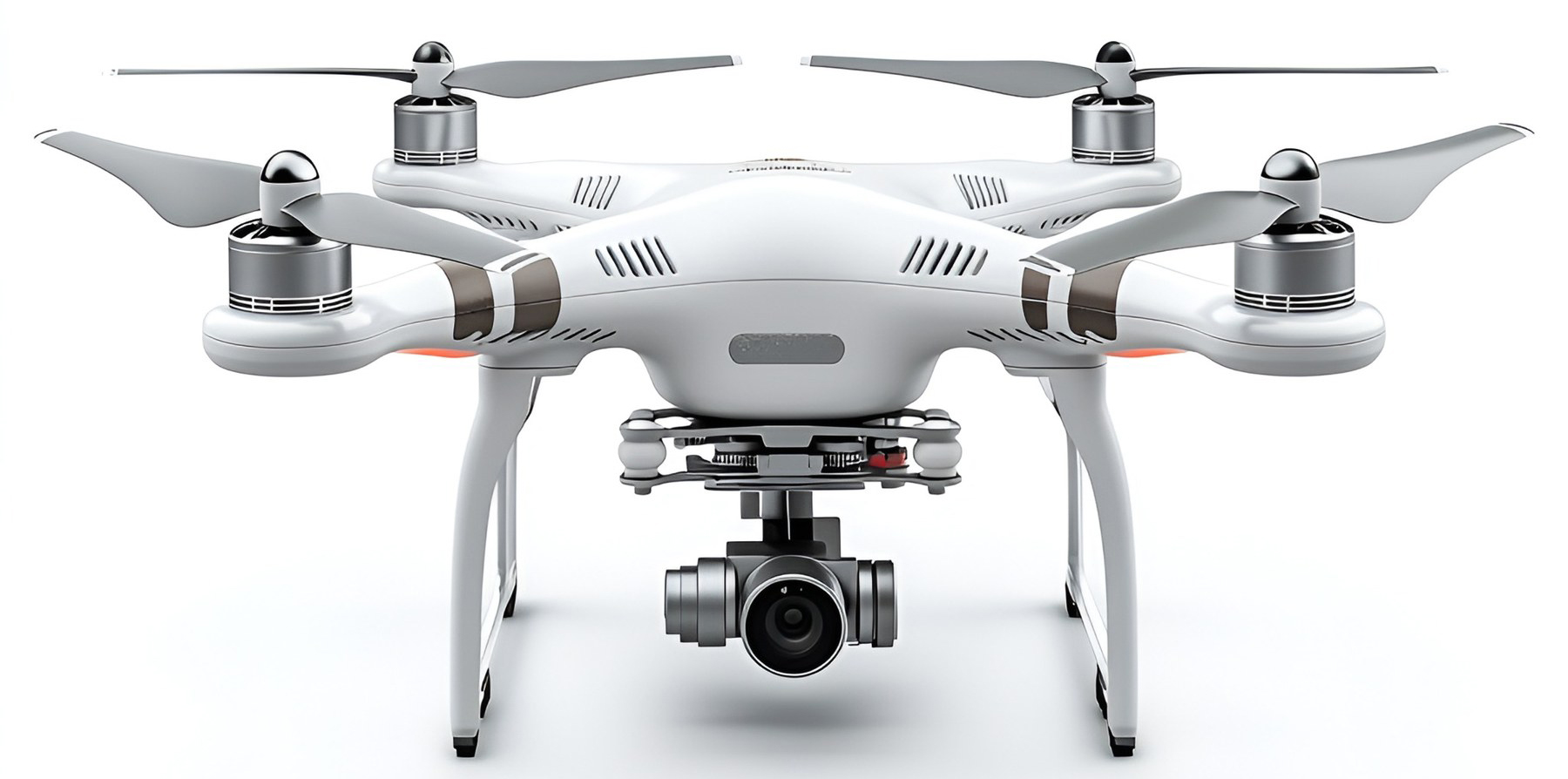
Scope of this Insight This page focuses on commercial and industrial drones, unmanned aircraft, epoxy composite housings, fairings, covers, syntactic structures and lightweight component design. It does not claim that microsphere-filled epoxy is suitable for primary flight-critical structure without the required part-level qualification.
iM16K typical density in the supplied UAV source.
iM16K crush-strength value in the supplied source.
S28HS typical density in the supplied UAV source.
S28HS crush-strength value in the supplied source.
01 THE UAV WEIGHT CHALLENGE: EVERY GRAM COMPETES WITH FLIGHT TIME
The supplied source makes the design logic explicit: excess mass reduces flight time, payload capacity and range. It contrasts conventional heavy fillers with hollow glass microspheres and frames glass bubbles as a route to lower-density composite parts. The same source reports up to 15% part-weight reduction in its UAV examples, while emphasizing that mechanical integrity must still be maintained.
Lower structural mass can be traded for battery, payload or endurance.
Lightweight covers and housings matter most when the whole aircraft is small.
Epoxy lightweighting extends beyond multirotors into fixed-wing platforms.
THE BEST LIGHTWEIGHT FILLER IS NOT THE ONE WITH THE LOWEST DENSITY ALONE.
For a real UAV part, the optimum filler must survive processing, keep viscosity manageable and preserve the mechanical, dimensional, dielectric and environmental performance the aircraft requires.
02 iM16K VS S28HS: TWO DIFFERENT EPOXY DESIGN WINDOWS
Both grades are hollow glass microspheres, but they solve different problems. iM16K trades some density advantage for very high crush resistance. S28HS is substantially lighter and still provides a 3,000 psi crush-strength class. The result is a useful design split between more demanding processing/parts and ultra-low-density epoxy systems.
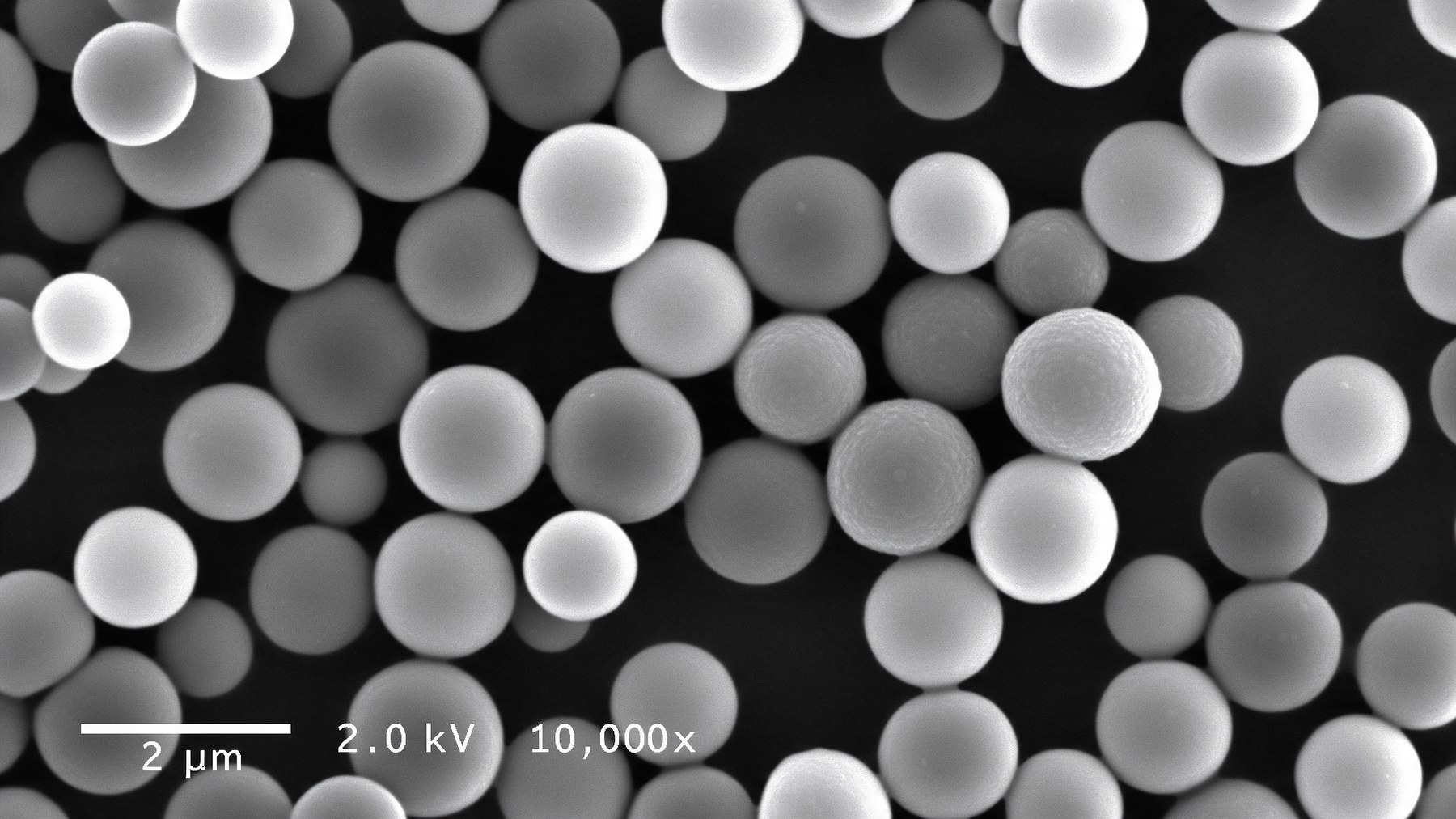
The design variable is controlled hollow volume. Each sphere replaces a portion of dense resin/mineral-filler volume with a closed hollow particle. The achievable part-weight reduction depends on how much bubble volume the formulation can carry while still meeting processing and mechanical requirements.
03 WHERE THE EPOXY SYSTEM CAN FIT IN DRONES & UNMANNED AIRCRAFT
The uploaded source identifies body shells, motor-mount areas, battery plates, fairings, antenna covers, syntactic cores and electronics insulation as UAV development areas. For an epoxy-centric design program, the most credible targets are semi-structural or non-primary composite components where weight, dimensional stability, processability and environmental resistance all matter.
| UAV / drone component | Primary design need | Likely grade direction | What must be validated |
|---|---|---|---|
| Battery enclosure / protective housing | Weight reduction + process survival | iM16K | Impact, screw/insert retention, thermal cycling, flame/electrical requirements |
| Motor bracket / connector housing | Higher local mechanical demand | iM16K | Flexural strength, fatigue, vibration, fastener loading, sphere survival |
| Fairing / aerodynamic cover | Ultra-low weight + smooth surface | S28HS | Impact, surface finish, UV/weathering, attachment integrity |
| Antenna / RF cover | Low mass + dielectric control | S28HS / selected grade | Dielectric constant, loss tangent, moisture uptake, RF transparency |
| Syntactic epoxy core | Low-density volume + dimensional stability | S28HS | Compression, shear, water uptake, thermal cycling, bonding to skins |
| General epoxy housing / panel | Weight reduction with robust processing | iM16K or S28HS | Part geometry, required stiffness, process pressure and target density |
Inspection, mapping, environmental monitoring and delivery all benefit from efficient payload-to-mass ratios.
Housings, covers and enclosures become meaningful weight contributors at scale.
Lightweight epoxy composite concepts also extend to non-primary unmanned-aircraft structures.
04 WHY HEAVY MINERAL FILLERS WORK AGAINST FLIGHT-WEIGHT REDUCTION
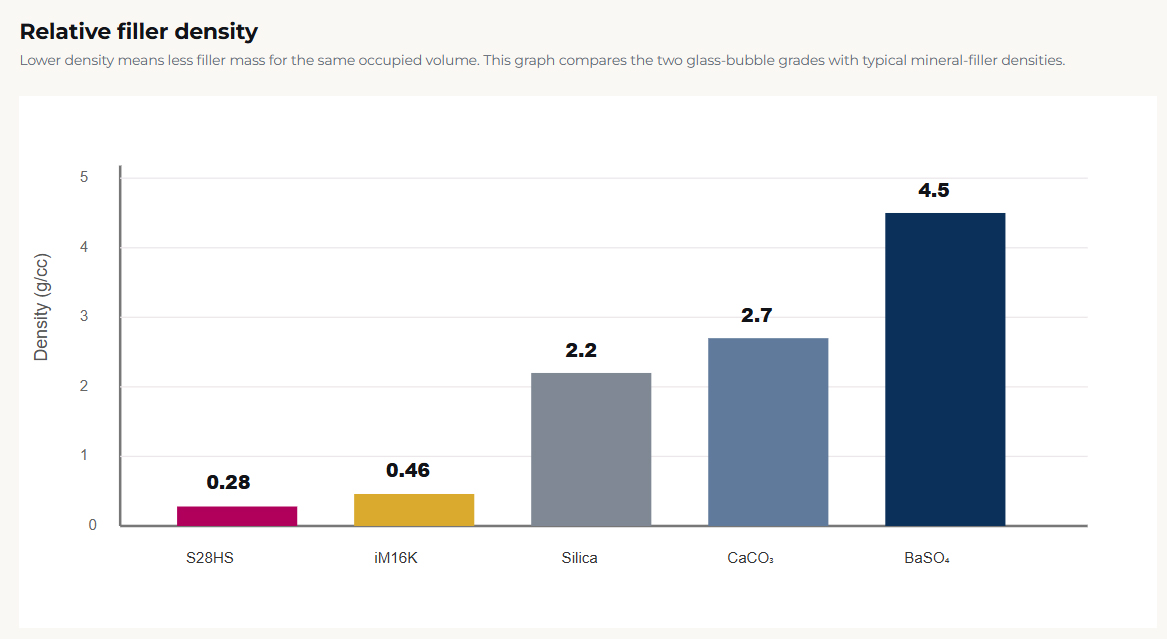
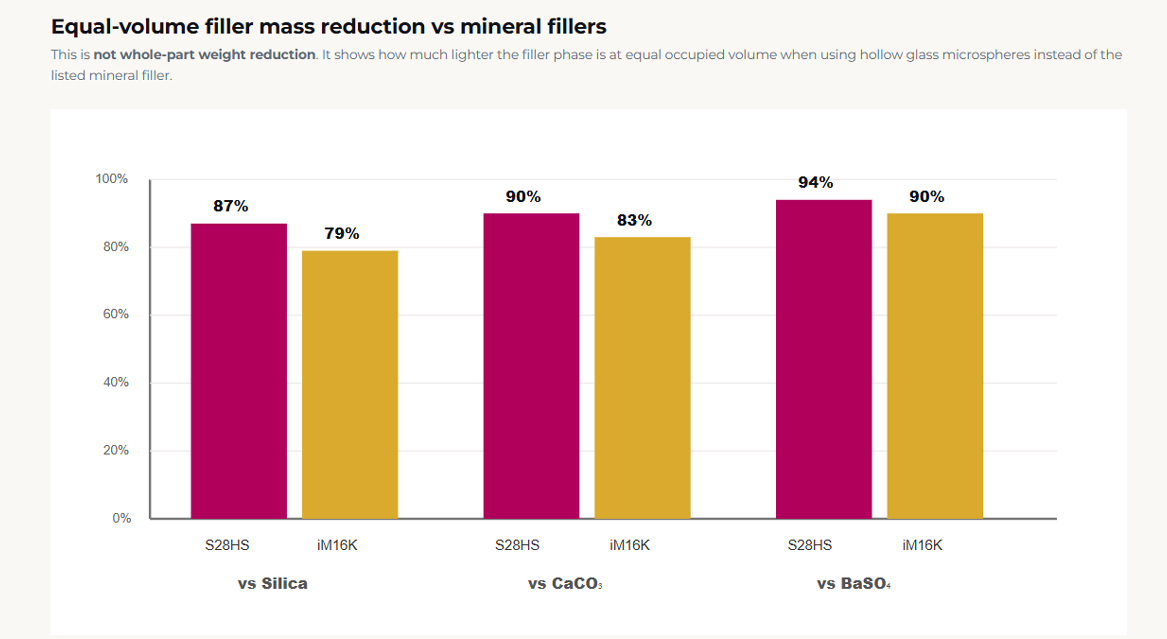
Silica, calcium carbonate and barium sulfate can each be useful in epoxy systems, but their design objective is usually not lightweighting. Silica may add hardness or rheology control, calcium carbonate is economical and easy to source, and barium sulfate is useful when high density or radiopacity is desired. In an aircraft-weight budget, however, their density is the central disadvantage.
| Property / filler | 3M iM16K | 3M S28HS | Silica | BaSO₄ | CaCO₃ |
|---|---|---|---|---|---|
| Typical density (g/cc) | 0.46 | 0.28 | ~2.2* | ~4.5* | ~2.7* |
| Relative filler mass at equal volume | Very low | Ultra-low | High | Very high | High |
| Published bubble crush strength | 16,000 psi | 3,000 psi | Not applicable | Not applicable | Not applicable |
| Typical epoxy role | High-strength lightweighting | Ultra-low-density lightweighting | Rheology / hardness / reinforcement | High-density functional filler | Economical extender / bodying filler |
| Lightweight UAV suitability | High for demanding parts | High where low density dominates | Useful only when its functional benefit justifies mass | Generally poor for weight-sensitive parts | Limited for aggressive lightweighting |
05 DENSITY ADVANTAGE: WHAT THE NUMBERS ACTUALLY MEAN
06 EPOXY PROCESSING: PROTECT THE SPHERE, CONTROL THE RHEOLOGY
The supplied source describes broad resin/process compatibility and a “ball-bearing” flow effect from spherical geometry. In epoxy, the practical objective is to disperse the bubbles uniformly without unnecessarily damaging them, while controlling viscosity, entrained air, cure and final part density.
Establish the unfilled epoxy baseline: viscosity, cure profile and mechanical properties.
Add hollow glass microspheres in a controlled sequence after aggressive dispersion steps where practical.
Track mixed density and viscosity as loading increases; do not use filler percentage alone as the control variable.
Verify sphere survival and cured-part performance under the actual casting, coating or molding process.
Design around the actual part. Lightweighting should be validated at component level-housing, fairing, cover, core or enclosure-not inferred from filler density alone.
LOWER DENSITY IS THE OPPORTUNITY. SPHERE SURVIVAL IS THE GATEKEEPER.
iM16K becomes attractive when process pressure and shear demand more crush resistance. S28HS becomes attractive when very low density is the dominant objective and the process window remains compatible with its strength class.
07 TECHNICAL FAQ
Technical references used for this Insight
- Geocon / “Elevate Every Flight: 3M Glass Bubbles for Drone & UAV Parts”: source for UAV weight challenge, applications, iM16K and S28HS density/crush-strength positioning, grade comparison and processing-compatibility statements.
- Typical mineral filler densities: used as general engineering reference values for silica (~2.2 g/cc), CaCO₃ (~2.7 g/cc) and BaSO₄ (~4.5 g/cc). Supplier-specific values should be used for actual formulation design.
Third-party copyright / trademark notice: 3M™ and 3M Glass Bubbles™ are trademarks of 3M Company. Geocon Products does not claim ownership of 3M trademarks. Third-party names are referenced solely for technical identification and educational discussion. This Insight uses independently written text, Geocon-created charts and user-supplied imagery rather than reproducing copyrighted 3M brochure artwork. Final suitability for any drone or unmanned-aircraft component must be established through the responsible manufacturer’s own engineering qualification.
LIGHTER FILLER IS ONLY USEFUL WHEN THE PART STILL PASSES.
For epoxy composite screening with iM16K and S28HS, Geocon can support grade-selection discussions, density targets, processing considerations and application trials for drone and unmanned-aircraft components.