

Boron Nitride Powder
GPBN-01
Ultrafine hexagonal boron nitride powder engineered as a cooling filler for electrically insulating electronic coatings, encapsulants and thermal-interface formulations.
Move heat without creating an electrical pathway.
NEXABOR GPBN-01 is designed for electronic coating systems that must dissipate heat while maintaining electrical insulation. The platelet-like hexagonal structure can form thermally conductive pathways when correctly dispersed and oriented in the polymer matrix.
It is intended for formulation development in protective coatings, potting compounds, encapsulants, adhesives and thermal-interface materials. Final conductivity, viscosity and application behaviour depend on loading, particle orientation, resin chemistry, film thickness and processing.
Cooling with insulation:
Hexagonal boron nitride is often described as “white graphite” because its layered morphology supports heat transfer while remaining electrically insulating.
Separate Agglomerates
Wet the ultrafine powder uniformly in the selected resin or carrier.
Create Contact
Increasing filler contact helps establish continuous heat-transfer pathways.
Move Heat
Heat is conducted away from concentrated electronic hot spots.
Protect Circuits
The dielectric filler supports electrical isolation within the coating matrix.
Thermal Dissipation
Supports development of coatings that spread and transfer heat away from electronic components.
Electrical Insulation
Offers a non-metallic route to thermal management where electrical isolation is essential.
Ultrafine Integration
Fine powder format supports smooth films and use in thin-section coating development.
Chemical Stability
Inert ceramic chemistry is suited to durable protective electronic material systems.
Light Colour
White ceramic appearance is useful where dark conductive fillers are unacceptable.
Formulation Flexibility
Applicable to coating, adhesive, encapsulation and interface-material development.
matter.
Thermal Pathway Development
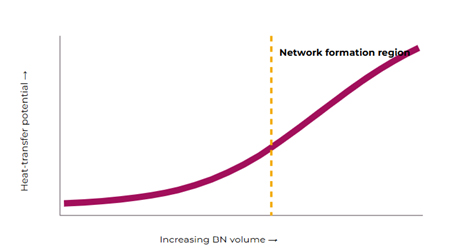
Qualitative relationship: particle contact and orientation become increasingly important as loading rises.
Cooling Filler Positioning
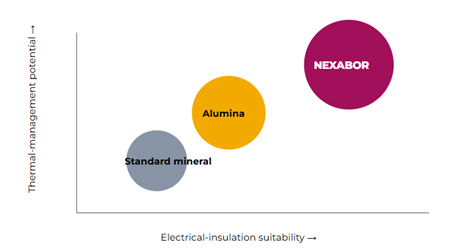
Qualitative positioning only. Actual comparison depends on grade, particle size, loading and matrix.
Select an electronic system.
Choose a category to review the role of GPBN-01.
Thermally Conductive Electronic Coatings
Applications
- PCB protective coatings
- Heat-spreading dielectric layers
- Power-electronics coatings
- LED and lighting assemblies
Potting Compounds & Encapsulants
Applications
- Power modules
- Sensors and control units
- Transformers and coils
- Battery electronics
Thermal-Interface Materials
Applications
- Gap-filling compounds
- Dielectric heat-transfer layers
- Thermal pads and sheets
- Component-to-housing interfaces
Thermally Conductive Adhesives
Applications
- Component bonding
- Heat-sink attachment
- LED assembly adhesives
- Electrically insulating structural bonds
Pre-Wet Carefully
Add GPBN-01 gradually to the liquid phase under controlled mixing to minimise dry pockets and airborne dust.
Control Shear
Use sufficient shear for deagglomeration while avoiding excessive processing that may damage platelet structure.
Manage Rheology
Track viscosity, thixotropy, levelling and sedimentation as filler loading increases.
Optimise Orientation
Processing can align platelets; measure both through-plane and in-plane thermal performance where relevant.
Validate the Film
Test adhesion, flexibility, cure, dielectric strength, thermal cycling and humidity resistance.
Check Compatibility
Confirm stability in the specific epoxy, silicone, polyurethane, acrylic or hybrid binder.
| PROPERTY | PRODUCT INFORMATION | RELEVANCE |
|---|---|---|
| Product Name | NEXABOR GPBN-01 | Electronic thermal-management additive |
| Chemistry | Hexagonal Boron Nitride | Thermally conductive, electrically insulating ceramic |
| Physical Form | Ultrafine Powder | Designed for coating and polymer incorporation |
| Colour / Appearance | Refer approved TDS | Batch acceptance criterion |
| Particle Size | Refer approved TDS | Influences smoothness, rheology and packing |
| Purity | Refer approved TDS | Important for electrical and thermal performance |
| Bulk Density | Refer approved TDS | Handling and volume-loading calculations |
| Moisture | Refer approved TDS | Storage and resin compatibility |
| Recommended Addition | Establish by formulation trials | Depends on target conductivity and viscosity |
Quick Formulation
Answers
Place approved PDF documents beside this HTML file using the assigned filenames.
Need Our Services?
Call: +91 97695 93030
Work Hours
Mon – Sat: 9:00 AM – 6:00 PM IST
Email Us
support@geoconproducts.com