

FLOWTHENE PF SERIES
Low-temperature, high-performance potassium formate/water heat-transfer fluids engineered for process cooling, refrigeration and closed-loop thermal service from −55°C to +218°C.
Move heat efficiently - without relying on glycol.
FLOWTHENE PF Series is a family of pre-mixed potassium formate/water heat-transfer fluids engineered for cold protection, heat transport and corrosion-controlled circulation. Five standard concentrations allow engineers to match fluid performance to the required cold-end set point.
Higher potassium-formate loading extends low-temperature protection but also increases cold-end viscosity and density. FLOWTHENE grade selection therefore balances freeze protection, pumpability, heat capacity, thermal conductivity and system pressure.
Engineered for safe, flexible thermal service.
Product claims and values below are taken from FLOWTHENE PF Series Datasheet Rev. 2026-01.
Pre-Mixed Solutions
Factory-prepared grades reduce on-site dilution work and concentration errors.
Non-Flammable
The datasheet states no flash or fire point for the aqueous ionic solution.
Protection to −55°C
Five grades cover progressively deeper low-temperature requirements.
Inhibitor Package
Multi-metal protection is included for compatible carbon steel, stainless steel, copper and brass systems.
Re-Inhibitable Fluid
Inhibitor levels can be tested and replenished through the fluid-care programme.
Custom Blends
Application-specific blends can be produced around defined process set points.
Select your FLOWTHENE
cold-end protection.
Maximum Cold Protection
Deepest standard protection and the only grade with a stated open-system range.
Product profile
- Freezing Point < −55°C
- Boiling Point 118°C
- Closed Range −10 to +218°C
- Viscosity at 20°C 3.20 mPa·s
- Density at 20°C 1340 kg/m³
- Heat Capacity at 20°C 2.701 kJ/kg·K
- Cold end: −50°C
- Closed-loop upper limit: +218°C
Industrial Refrigeration
Balanced low-temperature protection for refrigeration and process-cooling loops.
Product profile
- Freezing Point < −30°C
- Boiling Point 110°C
- Closed Range −10 to +218°C
- Viscosity at 20°C 2.10 mPa·s
- Density at 20°C 1237 kg/m³
- Heat Capacity at 20°C 3.212 kJ/kg·K
- Cold end: −20°C
- Closed-loop upper limit: +218°C
Low-Temperature Process Duty
Extended cold protection for demanding process equipment, test and refrigeration systems.
Product profile
- Freezing Point < −40°C
- Boiling Point 112°C
- Closed Range −10 to +218°C
- Viscosity at 20°C 2.50 mPa·s
- Density at 20°C 1275 kg/m³
- Heat Capacity at 20°C 3.077 kJ/kg·K
- Cold end: −30°C
- Closed-loop upper limit: +218°C
Deep-Cold Closed Loops
High-concentration grade for deep sub-zero closed-loop circulation.
Product profile
- Freezing Point < −50°C
- Boiling Point 115°C
- Closed Range −10 to +218°C
- Viscosity at 20°C 2.70 mPa·s
- Density at 20°C 1315 kg/m³
- Heat Capacity at 20°C 2.930 kJ/kg·K
- Cold end: −40°C
- Closed-loop upper limit: +218°C
Maximum Cold Protection
Deepest standard protection and the only grade with a stated open-system range.
Product profile
- Freezing Point < −55°C
- Boiling Point 118°C
- Closed Range −10 to +218°C
- Viscosity at 20°C 3.20 mPa·s
- Density at 20°C 1340 kg/m³
- Heat Capacity at 20°C 2.701 kJ/kg·K
- Cold end: −50°C
- Closed-loop upper limit: +218°C
All five grades at a glance.
Cold-end service, freezing point and boiling point are distinct selection parameters.
| Grade | Freezing Point | Boiling Point | Closed-System Range | Open-System Range | Typical Positioning |
|---|---|---|---|---|---|
| PF-10 | < −20°C | 108°C | −10°C to +218°C | — | Moderate sub-zero cooling |
| PF-20 | < −30°C | 110°C | −20°C to +218°C | — | Industrial refrigeration |
| PF-30 | < −40°C | 112°C | −30°C to +218°C | — | Low-temperature process duty |
| PF-40 | < −50°C | 115°C | −40°C to +218°C | — | Deep-cold closed-loop duty |
| PF-50 | < −55°C | 118°C | −50°C to +218°C | −51°C to +110°C | Deepest cold protection / open systems |
Open-system
service limits.
- PF-50 only
- −51°C to +110°C
- Systems exposed to atmosphere
- Periodic sampling
- Inhibitor maintenance
For systems exposed to atmosphere, the datasheet specifies PF-50 only, between −51°C and +110°C, with periodic sampling and inhibitor maintenance.
Thermophysical behaviour at 20°C.
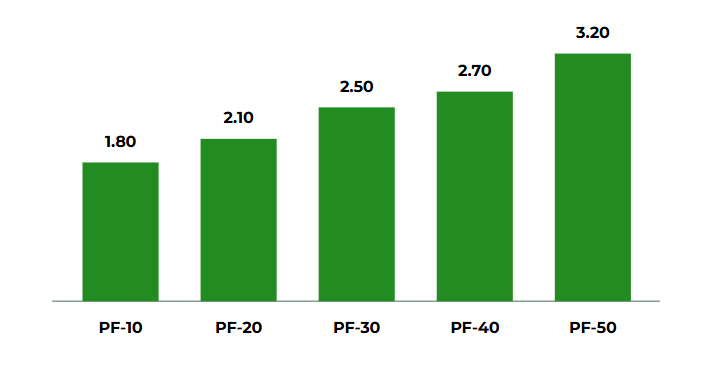
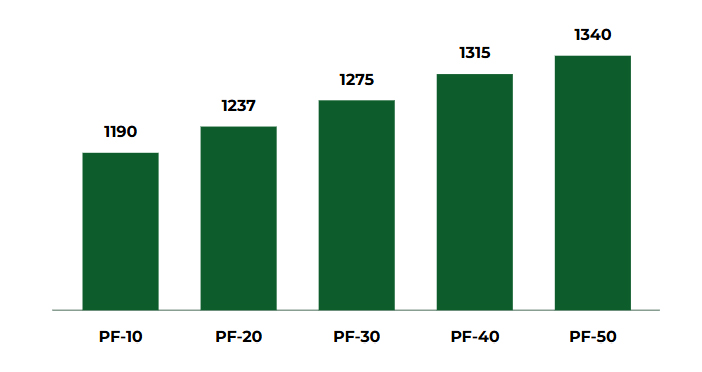
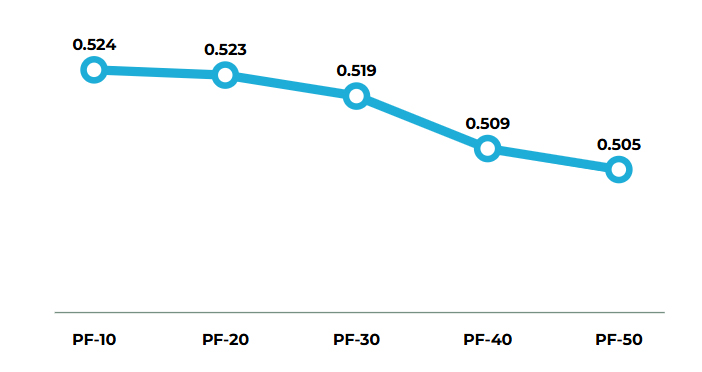
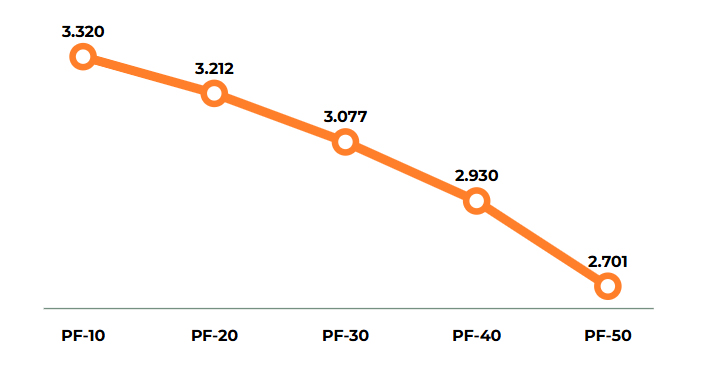
Data from FLOWTHENE PF Series Datasheet Rev. 2026-01. Higher loading trades deeper freeze protection for higher viscosity and lower heat capacity.
Dynamic Viscosity
mPa·s at 20°C
Density
kg/m³ at 20°C
Thermal Conductivity
W/m·K at 20°C
Specific Heat Capacity
kJ/kg·K at 20°C
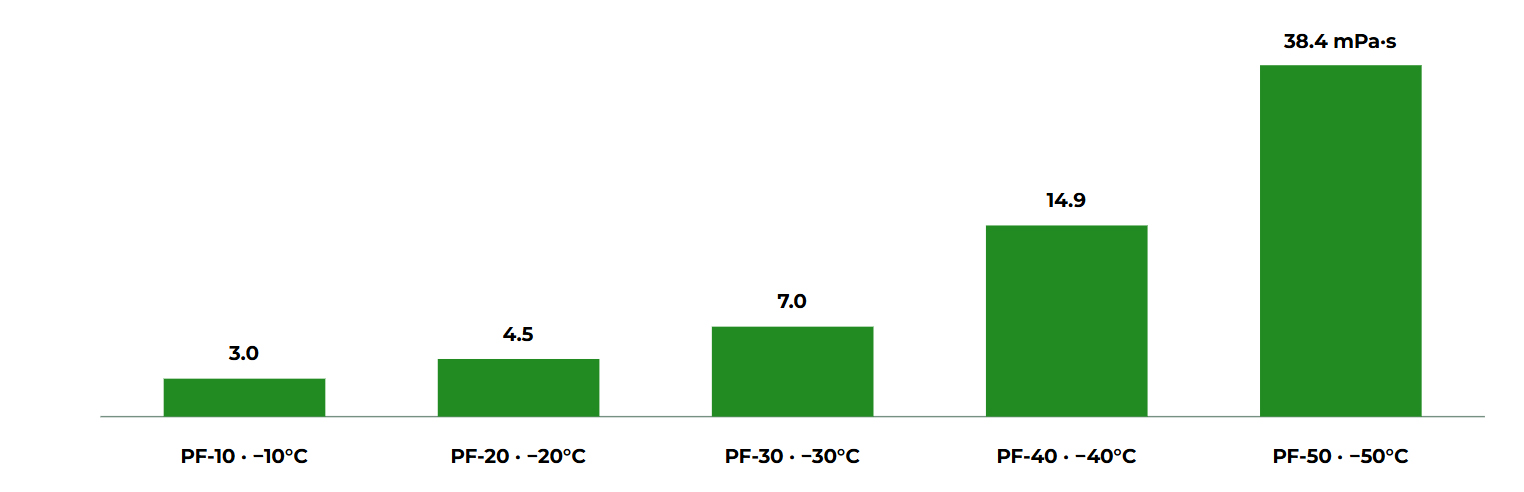
Cold-End Pumpability
Dynamic viscosity at each grade's stated cold-service endpoint
One fluid family across
heating and cooling duties.
System design, metallurgy, seals, pressure rating and operating envelope must be reviewed before selection.
Jacketed Process Equipment
Controlled reactor, vessel and batch-process temperature management.
Secondary Cooling Loops
Non-flammable aqueous heat-transfer route for suitable processing installations.
Industrial Cold Systems
Low-temperature circulation for cold rooms and process refrigeration.
Heating & Cooling Cycles
One fluid family spanning sub-zero cooling and closed-loop heating.
Civil & Mining Projects
Deep-cold secondary fluid for evaluated ground-freezing systems.
Climatic Chambers & Wind Tunnels
Stable temperature-control fluid for environmental test equipment.
Ice & Snow Melting
Circulating-fluid route for compatible hydronic snow-melt installations.
Alternative Fluid Evaluation
Potential replacement route for glycol, CaCl₂, TCE, methylene chloride or silicone after engineering review.
Application-Specific Blends
Custom concentration and fluid-care planning for defined process set points.
Manage the fluid-not just the fill.
Annual on-site or send-in testing supports early intervention and longer managed service life.
Sample
Collect representative fluid from the circulating system.
Test
Track pH, reserve alkalinity, freeze point and inhibitor levels.
Interpret
Compare results with commissioning data and operating history.
Re-Inhibit
Replenish inhibitor or correct concentration before system risk increases.
Design the circuit around the selected grade.
Refer to the FLOWTHENE engineering guide and grade tables for final calculations.
Use Temperature-Specific Viscosity
Cold-start pressure drop and pump power should be calculated at the lowest actual fluid temperature.
Allow for Thermal Volume Change
Size expansion capacity across the full operating temperature range.
Check Vapour Pressure
Closed-system rating and relief settings must exceed operating vapour pressure with a safe engineering margin.
Confirm Compatibility
Review metals, elastomers, seals, pumps and joining materials before commissioning.
Protect the Inhibitor Package
Use approved make-up practices and avoid uncontrolled dilution or contamination.
Establish a Fluid Baseline
Record initial pH, concentration, freeze point and inhibitor status for future comparison.
From laboratory trial to bulk tanker.
Pricing scales with volume; custom blends and re-inhibition planning are available.
Trial & Small Systems
1, 2.5 and 5-gallon containers.
Drums
For maintenance fills and compact installations.
IBC Tote
Efficient handling for industrial system charging.
Bulk Tanker
Large-volume supply for major installations.
Quick engineering
answers.
Key questions regarding FLOWTHENE grade selection, open-system use, glycol replacement and annual fluid testing.
Need Our Services?
Call: +91 97695 93030
Work Hours
Mon – Sat: 9:00 AM – 6:00 PM IST
Email Us
support@geoconproducts.com