
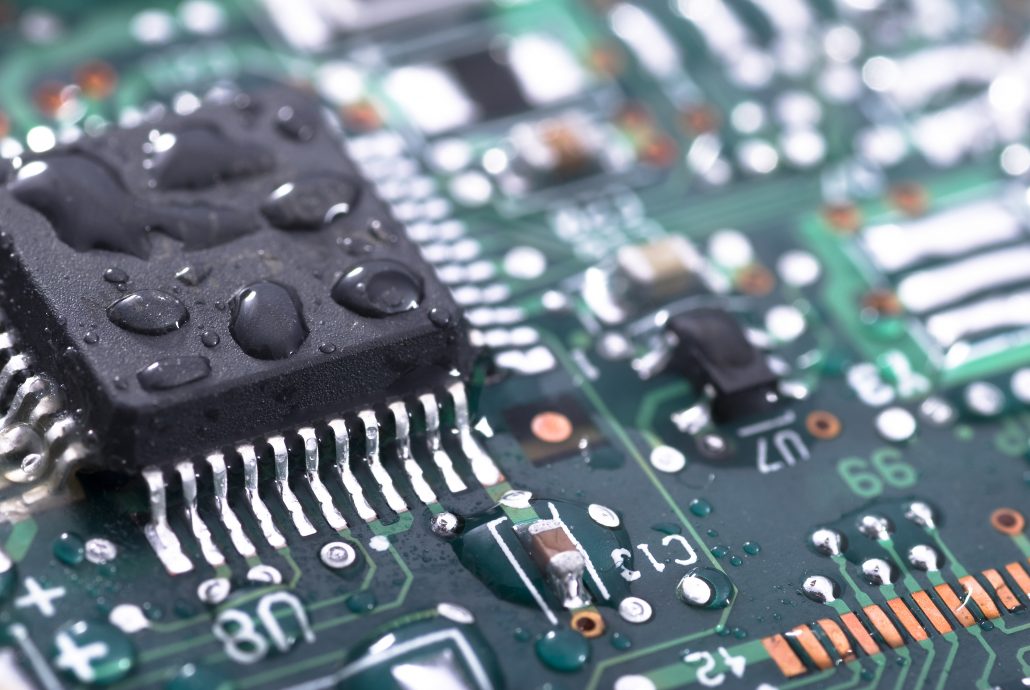
PRECISION BEGINS AT THE SURFACE WITH SURFLON™ S-386
Scope of this Insight: Electronics only This page intentionally excludes construction, architectural coatings, flooring, stone, cementitious systems and other non-electronics applications. Every formulation example, graph, troubleshooting note and FAQ below is restricted to PCB, conformal coating, electronic resist, functional ink, potting/encapsulation and electronics-cleaning applications.
Active content listed by AGC Seimi for SURFLON S-386.
Oligomer-type fluorosurfactant; useful where ionic character is undesirable.
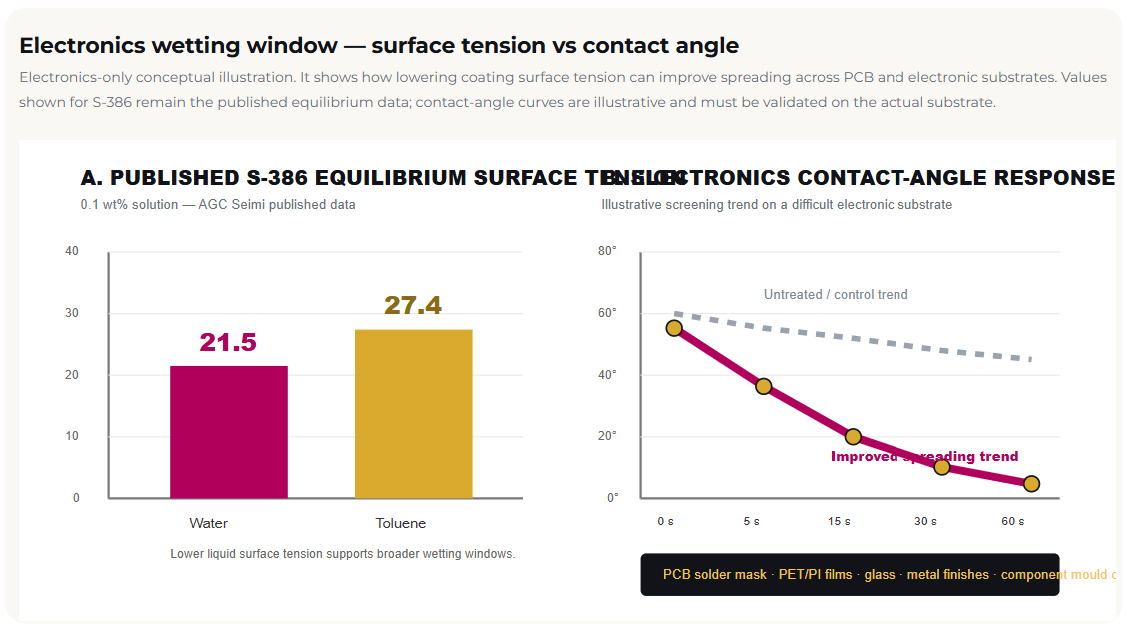
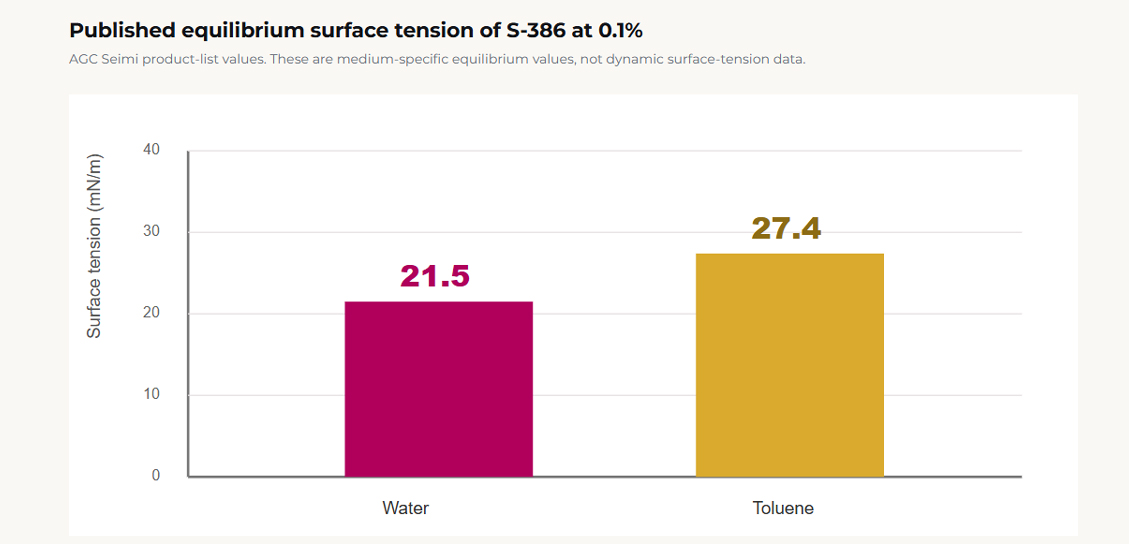
mN/m equilibrium surface tension at 0.1% in water, per AGC product list.
mN/m equilibrium surface tension at 0.1% in toluene, per AGC product list.
01 WHY THE SURFACE DECIDES THE COATING
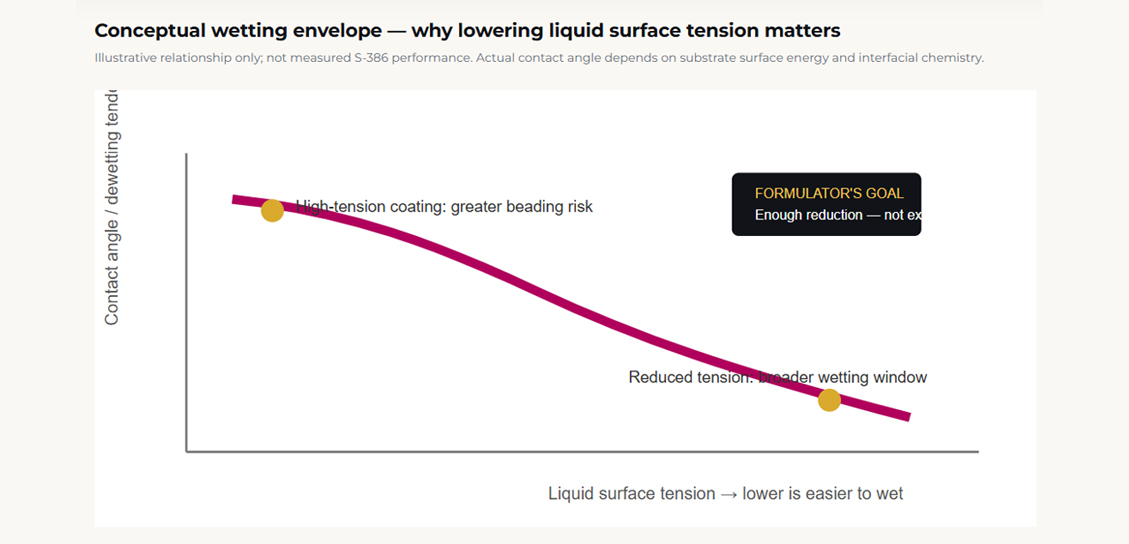
Wetting is governed by the balance between the liquid coating's surface tension and the surface energy of the substrate. A practical formulation rule is that a liquid must have sufficiently low surface tension relative to the substrate to spread rather than bead or retract. On a PCB, however, the “substrate” is not one material: copper, solder mask, tin or nickel finishes, component mould compounds, labels, adhesives, flux residues and fingerprints can all exist within millimetres of one another.
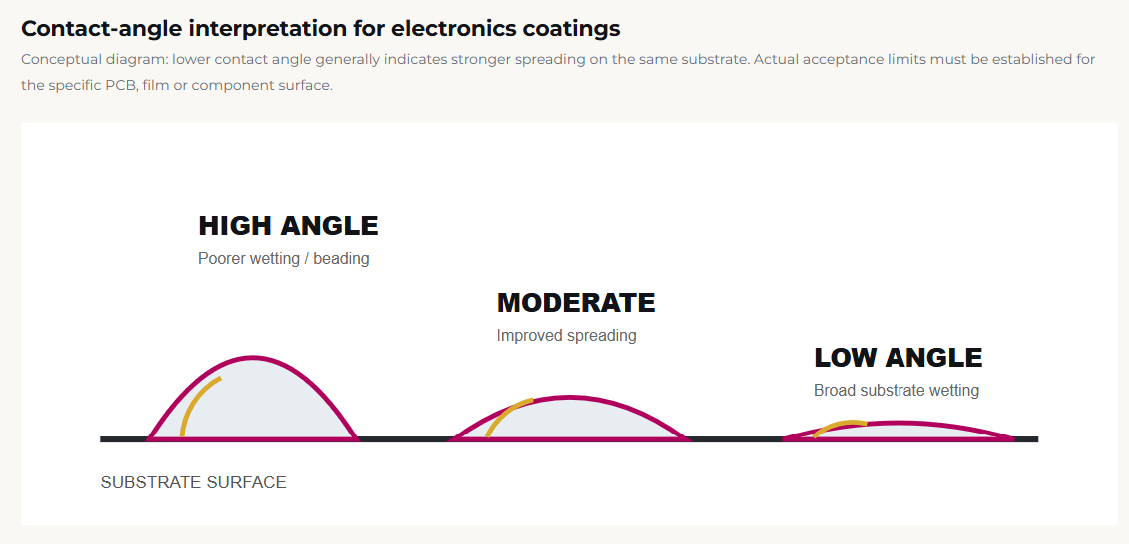
Young's equation links solid surface energy, liquid surface tension, interfacial tension and contact angle. In practical formulation terms, a lower contact angle generally means a liquid spreads more completely. When contact angle remains high, thin areas, edge pull-back, craters and uncoated islands become more likely.
THE TARGET IS NOT THE LOWEST POSSIBLE
SURFACE TENSION.
The target is the lowest practical dosage that creates robust wetting across the real substrate set without compromising cure, adhesion, recoatability or reliability.
02 SURFLON S-386 — TECHNICAL PROFILE
AGC Seimi classifies S-386 as a nonionic oligomer-grade fluorosurfactant. The official product list describes it as a 100% active viscous liquid with specific gravity about 1.1 at 25°C. The same source reports equilibrium surface tension of 21.5 mN/m for a 0.1% aqueous solution and 27.4 mN/m for a 0.1% toluene solution.
| Property | Published information | Formulation relevance |
|---|---|---|
| Ionicity | Nonionic | Avoids deliberately adding ionic surfactant functionality; final ionic cleanliness still depends on the full formulation. |
| Active content | 100 wt% | Very low additions can deliver meaningful interfacial effects; dosing accuracy becomes important. |
| Appearance | Viscous liquid / light-yellow viscous liquid | Pre-dilution can simplify accurate low-level addition in production. |
| Specific gravity | Approx. 1.1 at 25°C | Useful for volumetric-to-gravimetric conversion during plant trials. |
| 0.1% in water | 21.5 mN/m | Demonstrates strong equilibrium surface-tension reduction in aqueous media. |
| 0.1% in toluene | 27.4 mN/m | Shows activity in a non-aqueous aromatic solvent environment. |
Solubility window relevant to electronics formulation work
| Medium | Reported solubility | Practical note |
|---|---|---|
| Water | >10% | Suitable starting point for aqueous screening. |
| Methanol | >10% | High polarity; useful as a compatibility reference. |
| IPA | >10% | Convenient laboratory pre-dilution medium when compatible with the formulation. |
| MEK | >10% | Relevant to solvent-borne coatings and inks. |
| Ethyl acetate | >10% | Useful compatibility indicator for ester-containing systems. |
| Toluene | >10% | Shows solubility in aromatic solvent media. |
| n-Hexane | <0.1% | Very poor solubility in highly non-polar aliphatic hydrocarbon medium. |
03 WHERE ELECTRONICS NEEDS PRECISION WETTING
Electronic surfaces combine extreme topography with contamination sensitivity. Coating must flow around component bodies, solder joints, vias, edges and mask transitions while maintaining controlled thickness and cure. That makes wetting additives especially valuable as problem-solving tools—but only when they are used alongside disciplined cleaning and process control.
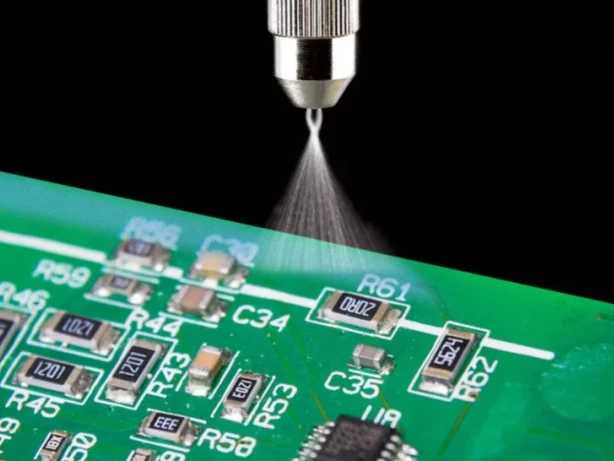
Conformal-coating application requires rapid spreading across a surface whose chemistry can change from pad to mask to component within a few millimetres. Image source: Shenzhen MHC.
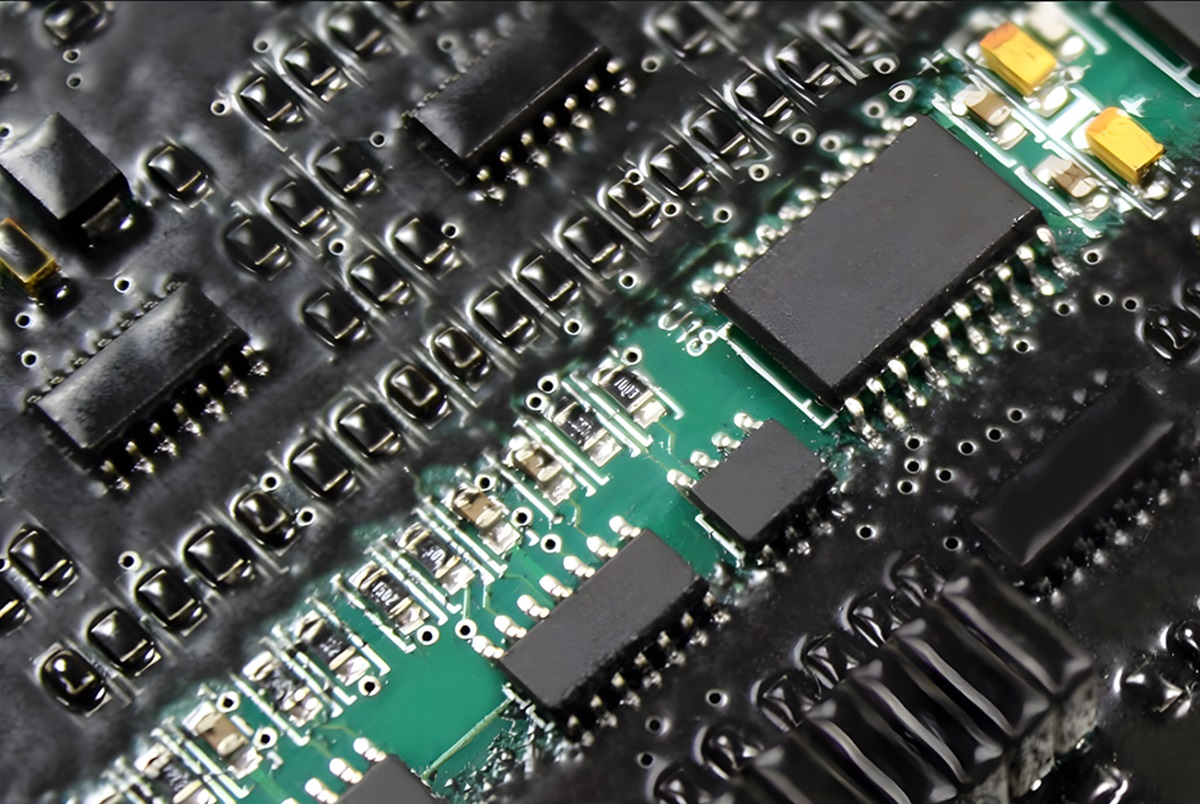
Film continuity around fine components and solder features is a surface-control problem as much as a viscosity problem. Image source: IPCB.
EDGE & COMPONENT WETTING
Improve film continuity on solder mask, component mould compounds and mixed-material topography. Validate adhesion and insulation performance independently.
LEVELING AT LOW FILM THICKNESS
AGC specifically cites fluorosurfactant use for leveling in non-aqueous resist systems. Surface uniformity becomes more critical as film thickness falls.
SPREAD WITHOUT UNCONTROLLED BLEED
Useful when low-energy films or treated polymer substrates resist wetting. Balance spread with line definition, cure and print resolution.
| Electronics application | Primary wetting challenge | What to validate after S-386 screening |
|---|---|---|
| Acrylic / PU conformal coating | Mixed-energy PCB surface, edge pull-back, flux residues | Coverage, adhesion, cure, dielectric / insulation tests, reworkability |
| UV-curable protective coating | Low viscosity + fast cure leaves little time for leveling | Cure conversion, oxygen inhibition, surface tack, adhesion, migration |
| Photoresist / resist coating | Ultra-thin film uniformity and low-defect leveling | Coat thickness, pinholes, development, imaging fidelity, residue |
| Functional / conductive ink | Wetting on PET, PI, glass, metal foil or coated films | Line width, edge acuity, conductivity, adhesion, print-to-print consistency |
| Potting / encapsulation | Penetration around components and into narrow gaps | Void content, adhesion, cure exotherm, thermal cycling, moisture performance |
| Electronics cleaner | Penetration under residues and difficult geometries | Residue, rinseability, material compatibility, ionic cleanliness |
Important distinction: wetting ≠ adhesion
Better spreading can remove interfacial voids and improve intimate contact, but chemical adhesion still depends on surface preparation, binder functionality, cure and interfacial bonding. Never replace adhesion testing with contact-angle data.
04 WHAT THE FLUOROSURFACTANT IS ACTUALLY DOING
Fluorosurfactants contain a fluorinated segment with exceptionally low surface-energy character and a medium-compatible segment. At low concentration they preferentially populate interfaces. AGC describes SURFLON functions in terms of reducing surface tension to improve wetting, penetration and leveling, and also notes the tendency of perfluoroalkyl groups to migrate toward surfaces.
S-386 disperses or dissolves in the liquid formulation.
Surface-active molecules migrate toward liquid/air and liquid/solid interfaces.
Interfacial free energy falls and the contact angle on difficult surfaces can decrease.
The liquid spreads more uniformly—provided contamination, viscosity and cure are also controlled.
Static versus dynamic surface tension
The AGC product-list values are equilibrium measurements. Fast electronics processes—spray, slot coating, flexo, gravure and inkjet—create new surface continuously. In these cases, dynamic surface tension may be more predictive than equilibrium values because the surfactant must reach a newly created interface within milliseconds to seconds. Bubble-pressure tensiometry is therefore useful when a formulation performs well in a slow drawdown but fails at production speed.
S-386 SHOULD BE VIEWED AS AN INTERFACIAL KINETICS TOOL, NOT JUST A LOW NUMBER ON A TENSIOMETER.
The critical question is whether the additive reaches the newly created interface fast enough under the actual coating process.
05 FORMULATION STRATEGY — USE THE MINIMUM EFFECTIVE LEVEL
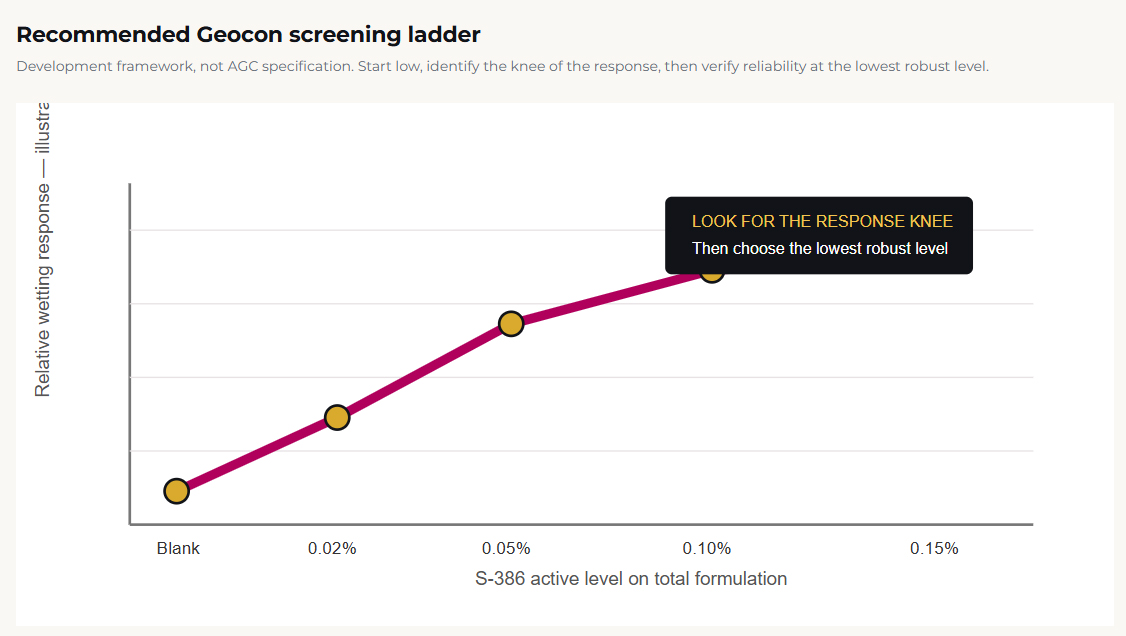
High-performance surface additives are most effective when used deliberately. Over-addition may create unnecessary surface migration, intercoat sensitivity, foam changes or loss of adhesion in some systems. The correct procedure is a dosage ladder with a blank control, followed by contact-angle and film-performance measurements on the real substrate.
Practical addition sequence
- Prepare the base formulation without S-386 and establish baseline viscosity, surface tension, contact angle and film appearance.
- For accurate low-level dosing, consider a pre-dilution in a compatible medium such as IPA or another validated solvent. Do not introduce a solvent that changes cure or VOC compliance unexpectedly.
- Post-add during let-down under moderate agitation unless the system demands another sequence. Avoid assuming that high-shear milling improves surfactant performance.
- Allow enough equilibration time before measuring surface tension and making drawdowns.
- Evaluate 0.02%, 0.05%, 0.10% and 0.15% active as a practical screening ladder, then narrow around the optimum.
- Repeat on production-representative substrates, including aged or cleaned boards—not only ideal laboratory panels.
Do not optimise S-386 in isolation.
Defoamers, silicone flow additives, dispersants, resin modifiers and contamination can all compete at the same interfaces. Surface-additive packages should therefore be evaluated as a system, not as independent ingredients.
06 MEASURE WHAT PRODUCTION ACTUALLY NEEDS
A sophisticated wetting additive deserves a sophisticated qualification plan. A visually smooth drawdown is not enough for electronics. The testing package should connect interfacial measurements to functional reliability.
| Test | What it tells you | Why it matters |
|---|---|---|
| Equilibrium surface tension | Final interfacial state after sufficient time | Useful formulation benchmark and dosage comparison |
| Dynamic surface tension | How quickly new surface is populated by surfactant | Critical for spray, inkjet and fast roll-to-roll processes |
| Contact angle | Actual spreading on a defined substrate | Direct wetting screen on solder mask, PET, PI, glass, metal or mould compounds |
| Dyne / surface-energy mapping | Variation across the incoming substrate | Separates formulation weakness from cleaning or process variation |
| Drawdown / spray panel | Cratering, crawling, edge coverage, leveling | Visual link between measurement and real film behavior |
| Adhesion | Bond strength after cure | Confirms wetting improvement did not create a weak boundary layer |
| Electrical reliability | Insulation / leakage behavior of the cured system | Essential for conformal coatings and protective electronic films |
| Thermal / humidity cycling | Long-term interface stability | Reveals failures not visible in initial appearance |
Electronics qualification must go beyond appearance. The final film may be hydrophobic or water-repellent by design, but that property should be evaluated only after confirming uniform coverage, cure, adhesion and electrical reliability. Image source: NanoSlic.
07 TROUBLESHOOTING — WHEN “MORE SURFACTANT” IS THE WRONG ANSWER
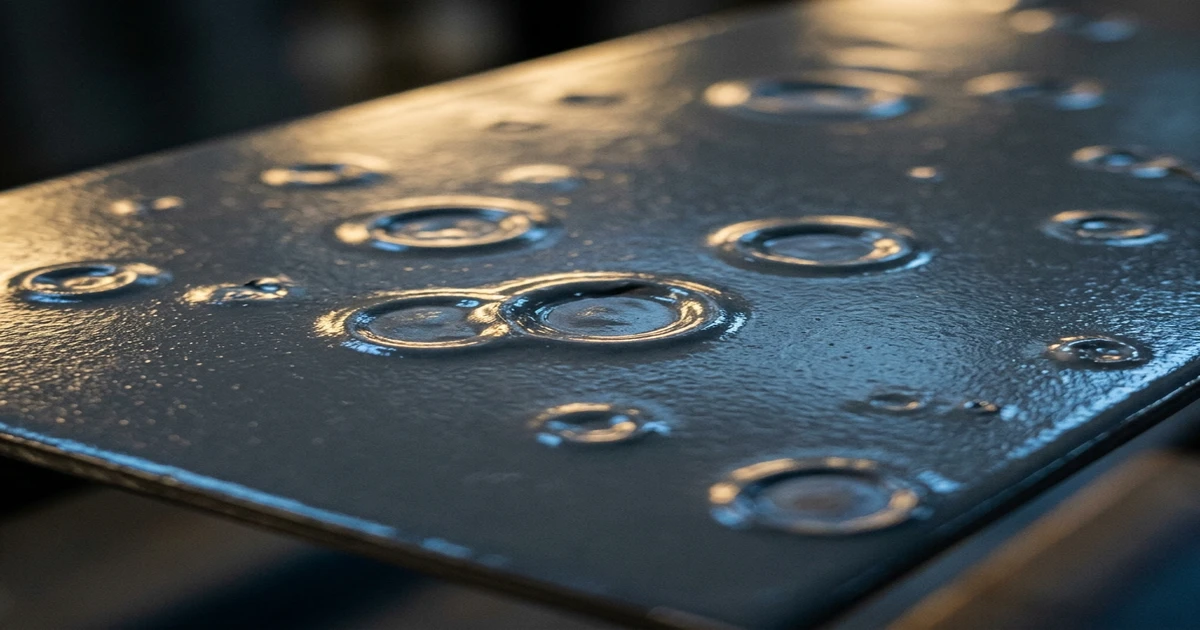
Fish-eyes and craters can originate from low-energy contamination, local surface-tension gradients or insufficient substrate wetting. A wetting additive can help only if the root cause is correctly diagnosed. Image source: Global Formulation.
FAST DIAGNOSTIC RULE
If a clean substrate wets well but production boards do not, investigate contamination and cleaning before changing the formulation. If both clean and production substrates show high contact angle, formulation surface tension becomes a stronger suspect.
| Observed defect | Likely checks before increasing S-386 |
|---|---|
| Fish-eyes / craters | Silicone/oil contamination, defoamer compatibility, surface-energy mapping |
| Edge pull-back | Dynamic surface tension, solvent evaporation rate, edge geometry, substrate energy |
| Pinholes | Entrained air, solvent release, substrate porosity, cure speed |
| Poor adhesion despite good wetting | Cleaning, resin chemistry, cure, weak boundary layer, excessive surfactant migration |
| Good lab drawdown, poor high-speed coating | Dynamic surface tension and surfactant migration kinetics |
| Recoat failure | Surface migration, over-dosage, contamination, insufficient intercoat preparation |
THE BEST SURFACE-ADDITIVE PROGRAM STARTS WITH A BLANK, NOT WITH A MAXIMUM DOSAGE.
Diagnose first. Reduce the interfacial barrier only as far as the application requires.
08 TECHNICAL FAQ
Technical references used for this insight
- AGC Seimi Chemical — SURFLON product list and S-386 physical properties.
- AGC Seimi Chemical — SURFLON functions and applications: leveling, wetting, dispersion and surface modification.
- SURFLON S-386 technical information sheet hosted by Geocon Products — solubility, appearance, ionicity and application summary.
- KRÜSS Scientific — contact angle, surface energy and surface tension in electronic-board production.
- HumiSeal / Chase — conformal-coating wetting problems, surface energy and defect diagnosis.
- BYK — substrate wetting and the relationship between coating surface tension and substrate surface energy.
© Technical reference note: SURFLON™ and S-386 are trademarks / product designations of AGC Seimi Chemical Co., Ltd. BYK®, HumiSeal®, KRÜSS® and other third-party names referenced in this Insight remain the property of their respective owners. These references are included solely for technical identification, attribution and educational discussion. Geocon Products does not claim ownership of third-party trademarks, text, graphics or proprietary materials, and no affiliation or endorsement is implied unless expressly stated. Technical concepts in this Insight have been independently summarized and interpreted by Geocon Products. Always refer to the latest manufacturer TDS/SDS and official technical literature before specification.
PRECISION SURFACE
CONTROL STARTS
WITH THE RIGHT
SCREENING PLAN.
For electronics coatings, conformal coatings, inks, resists or low-surface-energy substrates, Geocon can support dosage ladders, surface-tension screening and application evaluation of SURFLON™ S-386.