
Chemistry routes for moving crude and water through oilfield systems with less frictional pressure loss. Explore oil-soluble pipeline polymers and water-based friction reducers for high-rate operations.
Less pressure lost. More room to operate.
At high flow rates, turbulent motion inside a line consumes pressure. A suitable drag reducing polymer can lower frictional loss, helping teams evaluate greater flow at the same pressure or reduced pumping demand at the same flow.
The outcome is system specific. Pipe size and length, fittings, fluid salinity, temperature, solids, chemical compatibility and pump shear all affect the field result. GEODRAG distinguishes hydrocarbon pipeline DRAs from water soluble friction reducers for stimulation and transfer services.
Compare pressure loss at matched flow rates, then confirm dose response with the actual field water and equipment.
Choose the fluid. Then the polymer.
Open a chemistry window to see where it fits, the dose basis and available GEODRAG grade references. Hydrocarbon pipeline polymers and aqueous friction reducers require different fluid systems.
Polyalphaolefin
Ultra high molecular weight C6–C12 alpha-olefin polymer
Crude, condensate and compatible liquid-product lines
Polyacrylamide
High molecular weight PAM / HPAM, inverse emulsion
PA-3400 · liquid emulsion concept
Sulfonated Acrylamide
Acrylamide–AMPS water soluble copolymer
Brine, recycled water and selected coiled tubing fluids
Polyethylene Oxide
High molecular weight, water soluble non-ionic PEO
PO-3300 · powder concept
What changes inside the pipe?
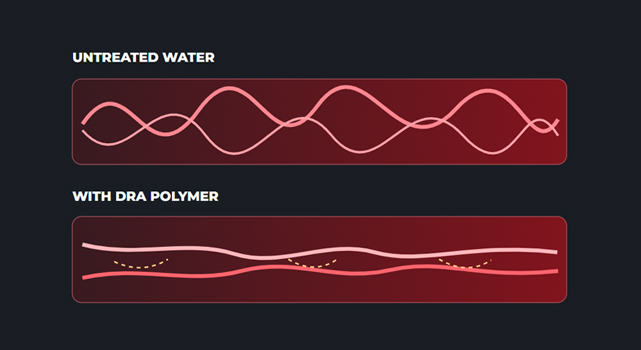
In turbulent flow, long polymer chains can damp energy consuming eddies and reduce the frictional pressure drop along the flow path.
This effect is different from simply increasing bulk viscosity. It is evaluated under relevant flow and shear conditions, ideally with a representative flow loop and the intended transported fluid.
Record the actual system
Measure untreated pressure drop and flow through representative pipe geometry, water and pumping conditions.
Test polymer addition
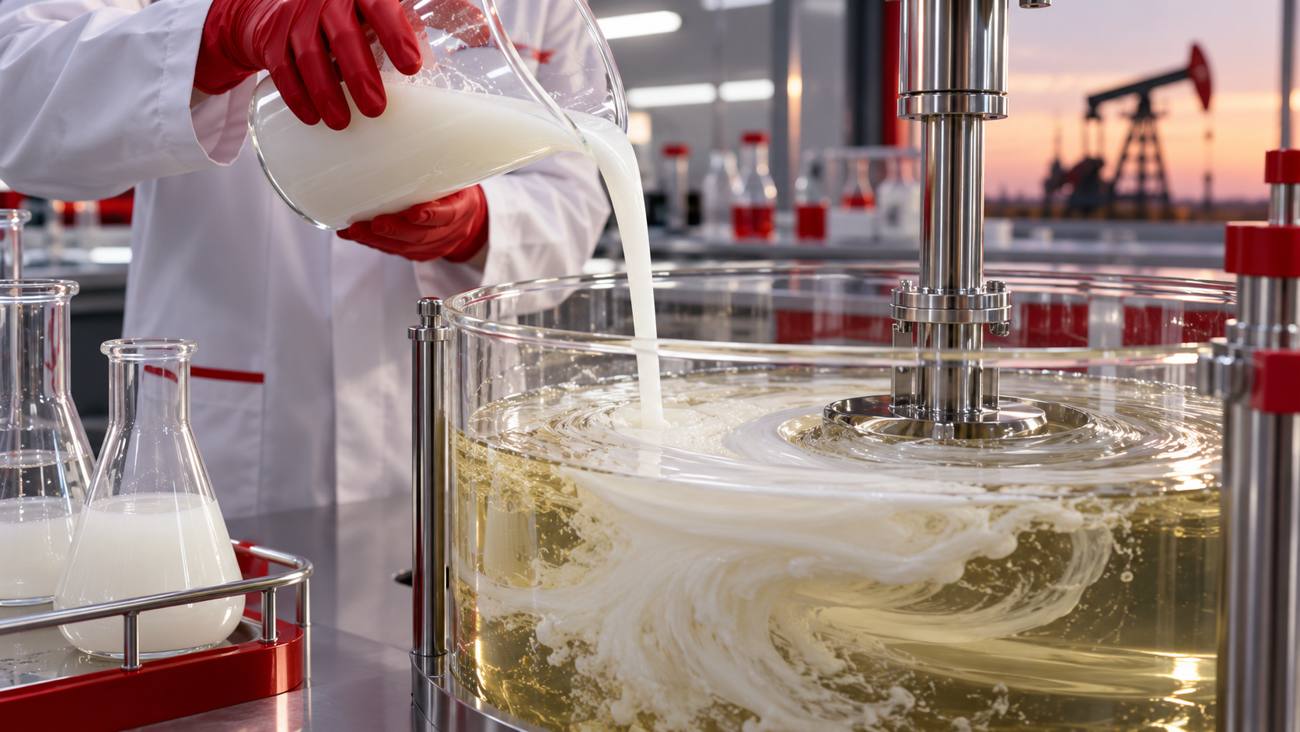
Evaluate mixing, inversion or hydration, then observe changes across a practical dosage range.
Check operating fit
Review shear history, compatibility, equipment limits and economics before setting field treatment.
Graph the pressure response.
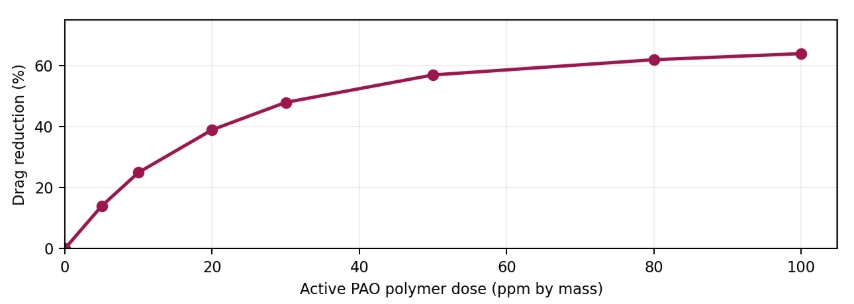
Hydrocarbon PAO: active polymer ppm by mass. Verify actual crude, dissolution and pump shear.
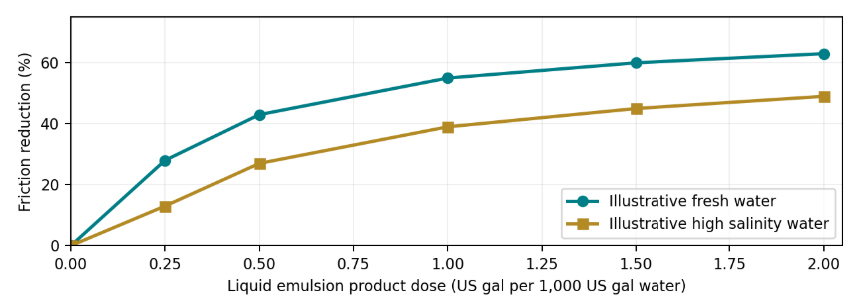
Aqueous emulsion: supplied-product gpt. Fresh and saline curves are conceptual and are not grade test data.
Where water based friction reduction matters.
Slickwater fracturing
Limit frictional pressure loss through surface iron and wellbore at the selected treatment rate.
Long distance transfer
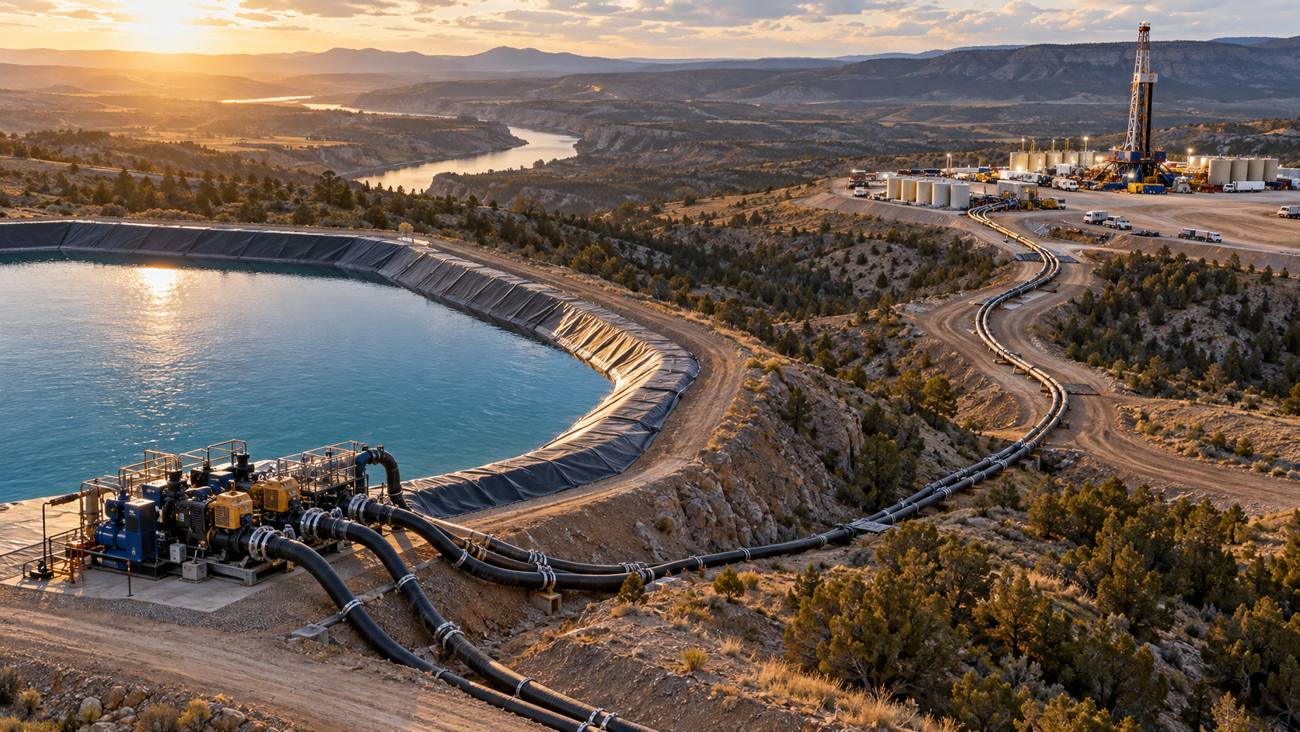
Screen flow and pressure across temporary or fixed transfer lines serving the pad.
Produced water blending
Evaluate polymer performance in the actual recycled water and its dissolved solids profile.
Water injection lines
Assess pressure drop and chemical compatibility in water disposal or injection service.
Coiled tubing circulation
Explore pumping headroom through restricted flow paths after a representative loop test.
Wellbore circulation
Assess potential friction reduction when pumping aqueous cleanout or completion fluids.
Start with the fluid. Then select the polymer form.
For a reliable selection, share the transported fluid and analysis, flow target, line dimensions, operating temperature, pump arrangement and other additives. Product form must suit the fluid family, dosing infrastructure and available mixing time.
Hydrocarbon pipelines: crude oil, condensate, refined products and NGL lines often use a distinct oil soluble polymer family, such as polyalphaolefin based DRAs. The aqueous EXPLORAX grades on this page should not be presented as substitutes for those chemistries without separate qualification.

Performance is validated with actual water and pumping conditions.
Before a field trial.
Technical guidance for understanding drag reduction, GEODRAG water-based friction reducers, fluid compatibility, grade selection and field evaluation.
No. A drag reducer is assessed by its effect on frictional pressure loss under flow. Bulk viscosity alone does not establish a friction reduction result.
GEODRAG-PA-3400 is the emulsion option. Metering and emulsion inversion must be checked under site conditions.
GEODRAG-PO-3300 is the powder route for operations equipped to wet, disperse and hydrate polymer before use.
PA-3400 and PO-3300 are water based platforms. Crude lines require a separately formulated oil-soluble DRA, such as PAO, and qualification in the actual hydrocarbon.
No fixed percentage can be stated without measured results in the target fluid and flow circuit. Compare a treated and untreated pressure drop at the same rate.
It may be screened, but salts, hardness, oxidants, suspended solids and other additives can alter polymer hydration or performance.
Technical background and literature dose basis: SLB dry friction reducer · Liquid slickwater dosing patent · PAO pipeline treatment patent. Literature ranges do not establish GEODRAG product specifications.
Have a flow target? Let’s evaluate the fluid and line.
Send us your water analysis, flow rate, pressure drop and operating conditions to identify a suitable starting point for screening.
Contact EXPLORAX ↗