

Low-density engineered spheres for lightweight oilfield fluids and cement systems. Explore the Geospheres HGM Series across drilling, completion and cementing operations.
Small spheres. A lighter fluid system.
Hollow glass microspheres are tiny, closed-shell particles whose trapped void reduces particle density. In a properly engineered formulation, they can lower the density of drilling fluids or cement slurries while maintaining a non-aerated fluid phase.
The formulation has to balance density reduction against particle survival, solids loading, rheology, fluid loss and compressive strength. Grade selection begins with the expected pressure path and the fluid or slurry recipe.

Designed around density control.
Lightweight drilling fluids
Screen lower fluid density for narrow pressure windows, depleted zones and formations sensitive to overbalance.
Lightweight cement slurries
Design lower-density cement systems where hydrostatic pressure and circulation losses constrain placement.
Completion and workover fluids
Evaluate density control and particle stability in water-based or compatible nonaqueous fluid systems.
Syntactic foam screening
Consider high-strength spheres in resin systems for thermal insulation or buoyancy after pressure and water-uptake qualification.
Weak formations
Model hydrostatic pressure and compare the lightweight system with conventional or foamed alternatives.
Reuse and reconditioning
Assess breakage and retained density after mixing, solids control and circulation before considering reuse.


Density
changes with
intact sphere
loading.
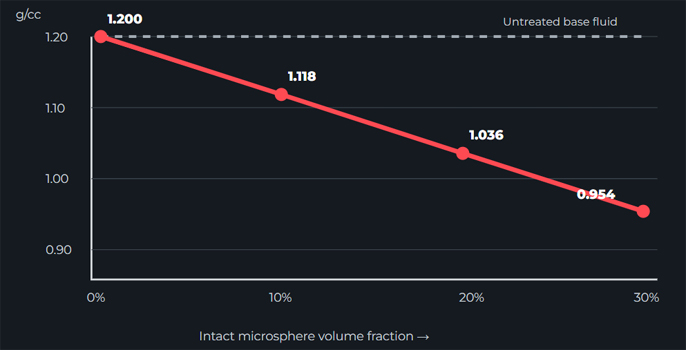
At equal base-fluid density, adding a lower-density intact particle phase can lower mixture density. Crush losses, trapped air and rheology can change the actual result.
Worked example only: ideal mixture density = (1 − volume fraction) × 1.20 + volume fraction × 0.38 g/cc. The 0.38 g/cc sphere density is a hypothetical input for the calculation, not a measured Geospheres result. Actual slurry density depends on formulation, entrained air and sphere survival.
Illustrative density calculation
Base fluid 1.20 g/cc · assumed sphere density 0.38 g/cc
Four grade references for formulation screening.
Select against required density, pressure exposure, particle size and processing conditions. The grade names identify the product candidates; they do not by themselves state certified crush strengths.
HGS 5000
Grade reference for lightweight fluid and cement formulation studies; the operating pressure window requires testing.
- Check true density and particle size
- Measure survival through processing
- Confirm slurry and fluid compatibility
HGS 7000
Grade reference for oilfield formulation studies; density and pressure durability require batch-specific results.
- Screen expected well pressure profile
- Check mixing and pump survival
- Compare density and strength targets
HGS 8000
Grade reference for cementing and engineered oilfield systems; pressure suitability requires validation.
- Validate pressure survival curve
- Measure post-circulation density
- Qualify job-specific application window
HGS 10000
Additional Geospheres reference for evaluation in oilfield fluids, cement and engineered composites; operating limits require grade-specific validation.
- Determine true density and D50
- Measure isostatic survival at relevant pressure
- Confirm processing and slurry performance
Compare the four HGM grades.
Density, isostatic survival and particle size must be measured for each grade. The table is ready for Geospheres batch data; numerical specifications will be added when the approved TDS and COA are available.
| GEOSPHERES GRADE | TRUE DENSITY | ISOSTATIC SURVIVAL AT TEST PRESSURE | D50 PARTICLE SIZE |
|---|---|---|---|
| HGS 5000 | To be confirmed | To be confirmed | To be confirmed |
| HGS 7000 | To be confirmed | To be confirmed | To be confirmed |
| HGS 8000 | To be confirmed | To be confirmed | To be confirmed |
| HGS 10000 | To be confirmed | To be confirmed | To be confirmed |
Qualification data for every grade.
| PROPERTY | WHY IT MATTERS | SUGGESTED TEST OUTPUT |
|---|---|---|
| True density | Determines attainable mixture density at given loading | Batch result with method and tolerance |
| Particle size distribution | Affects dispersion, pump passages and packing | D10 / D50 / D90 by volume |
| Isostatic crush survival | Measures sphere survival at selected test pressure | Survival fraction with pressure and test medium |
| Fluid and slurry rheology | Checks mixing, pumping and placement | PV/YP or application-specific profile |
| Post-process density | Detects sphere breakage during mixing and circulation | Before/after density and retained survival |
| Cement strength and fluid loss | Checks job-specific integrity and placement | Measured slurry test report |
Engineering questions.
Technical guidance for understanding hollow glass microspheres, density control, pressure survival, particle size, processing and Geospheres grade qualification.
Closed-shell particles offer a different density-control route. The tradeoffs in equipment, density stability and final cement properties depend on the actual design and must be compared in lab trials.
No. HGS 5000, 7000, 8000 and 10000 are requested Geospheres grade references. No Geospheres crush-strength specification was supplied for this page.
Both may be screened, but wetting, dispersion, rheology and chemical compatibility must be checked in the actual formulation.
No blanket assurance is possible. Evaluate pressure exposure and high shear points, then compare particle survival and density before and after processing.
Only after qualification in the chosen resin, including pressure survival, moisture uptake and thermal performance for the rated depth.
Oilfield photographs illustrate the application settings. The sphere close-up is a conceptual visualization, not a real micrograph or a batch-specific product photograph.
No. Lower density can improve density reduction, but shell strength, size distribution, processing losses and the required pressure window also matter.
The reported test pressure alone omits how many spheres remain intact. Compare pressure, survival fraction, test medium and test method together.
No. The grade reference does not certify a crush rating. The product name alone does not establish test pressure or survival fraction; those values require Geospheres test data.
Ask for a D10, D50 and D90 distribution by volume, plus the method. This helps assess dispersion, packing and equipment clearances.
An approved Geospheres TDS and representative batch COA with density, particle size and isostatic survival, including the test pressure, test medium and test method.
Send the density target and pressure profile.
Share the base-fluid or cement recipe, bottomhole conditions, expected peak pressure and mixing route so the right HGM grade can be screened.
Contact EXPLORAX ↗