CS
Reactive silica platform
Colloidal Silica
Stable aqueous silica nanoparticles for specialised
cementing formulations requiring controlled reactivity
and uniform silica distribution.


Engineered fluid separation and surface conditioning between drilling mud and cement—helping the cementing train move through the annulus with control, compatibility and purpose.
A cement spacer is a deliberately formulated fluid pumped ahead of cement. Its role is not simply to occupy volume: it must remain compatible with the fluids on both sides, assist removal of drilling-fluid residue, support hydraulic displacement and prepare casing and formation surfaces for cement contact.
Spacer performance depends on the complete job environment—mud chemistry, cement design, density hierarchy, rheology, temperature, annular geometry, circulation rate and contamination tolerance. EXPLORAX therefore treats spacer selection as a system-design exercise rather than a one-product decision.
Maintain a controlled buffer between drilling fluid and cement to reduce direct intermixing and adverse rheological interaction.
Support removal and transport of mobile mud, gelled residue and solids from the annular flow path.
Help leave casing and formation surfaces in a more suitable water-wet condition before cement arrives.
Provide suspension and solids-carrying behavior appropriate to job density, geometry and circulation conditions.
A spacer or cementing fluid is assembled from complementary chemistry platforms. Selection starts with the required function and is then verified against the actual mud, cement, water and downhole conditions.
Polysaccharide
Builds the fluid structure required for solids suspension,
carrying capacity and controlled spacer rheology.
Microsilica
Fine reactive silica used in cement systems where matrix
densification, reduced permeability and high-performance
cement properties are targeted.
Colloidal Silica
Stable aqueous silica nanoparticles for specialised
cementing formulations requiring controlled reactivity
and uniform silica distribution.
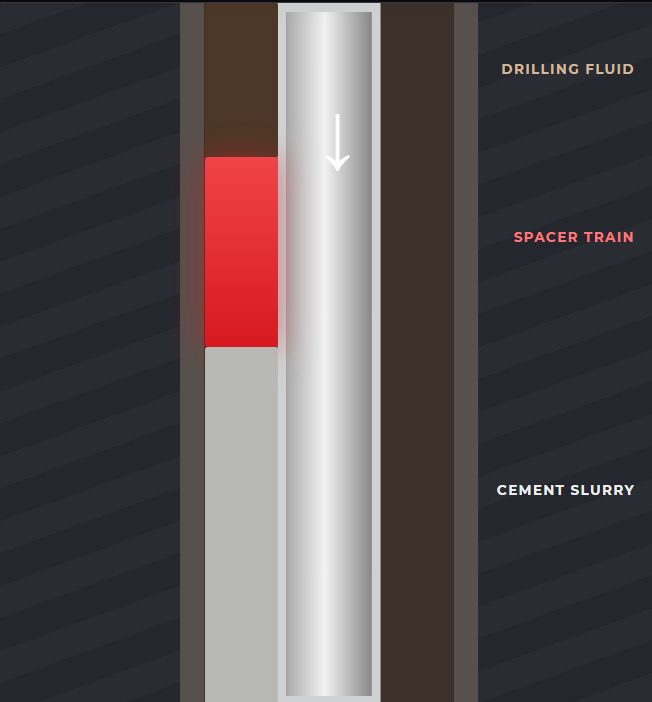
The spacer contacts residual mud and filter-cake surfaces while the pumping programme establishes annular movement.
Appropriate rheology and density help carry displaced material while retaining separation from the following cement.
Surfactant and formulation choices support the intended surface condition before cement placement.
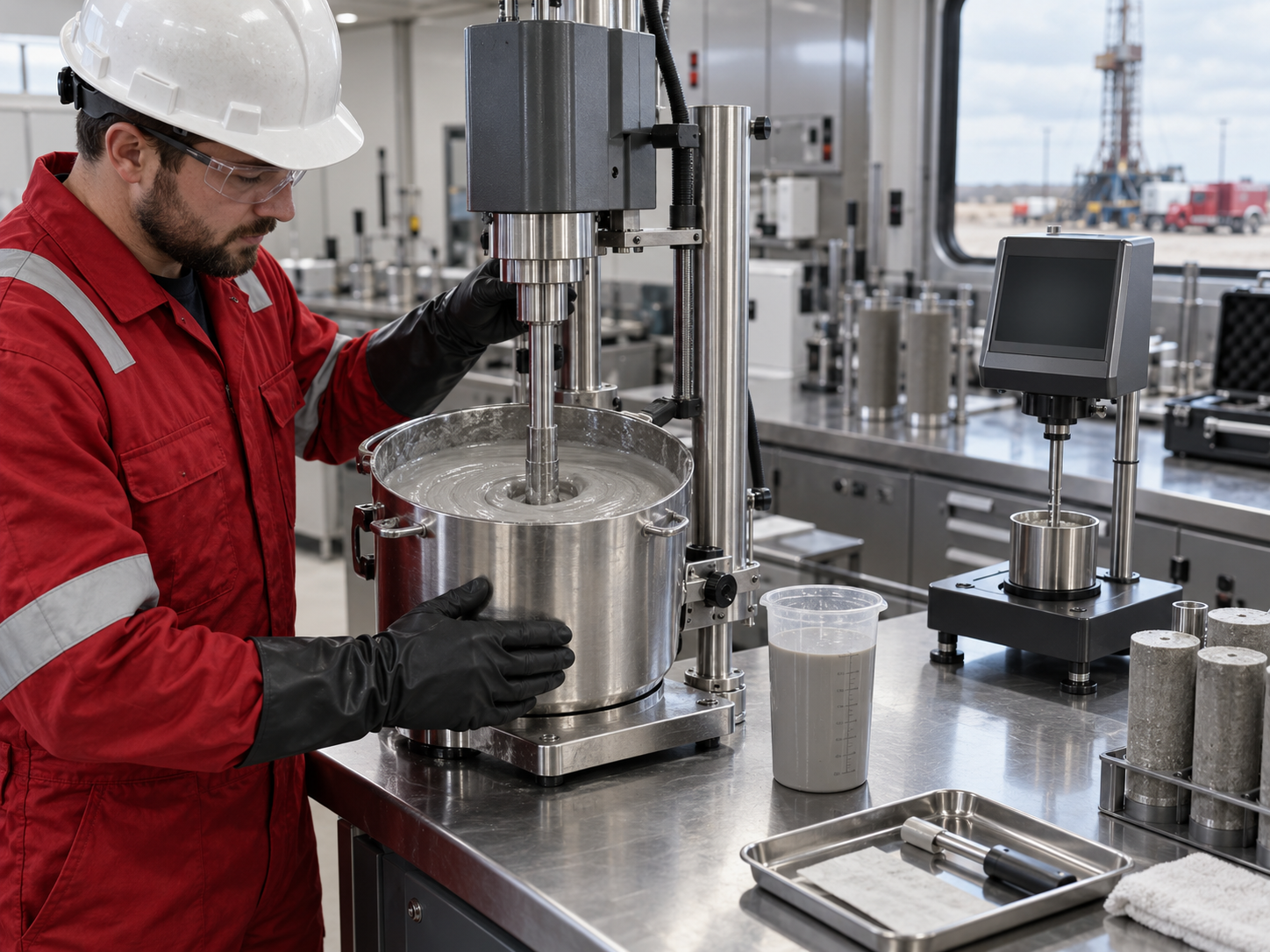
The additive package, water phase, weighting solids and ancillary chemicals must work together through mixing, static exposure and the intended shear history.
Mud–spacer and spacer–cement compatibility
Rheological hierarchy at relevant temperatures
Sag, settling and solids suspension
Foam tendency and air entrainment
Mixability, pumping sequence and contamination tolerance
Relative annular cleaning versus circulated spacer volume
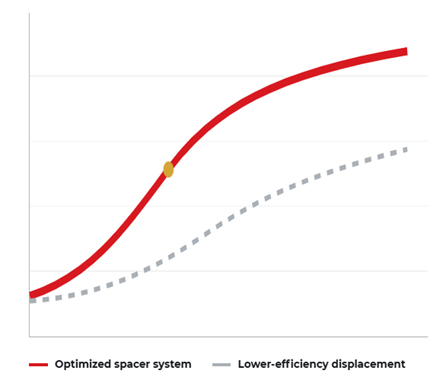
Spacer volume and contact time
Centralization and annular geometry
Circulation rate and flow regime
Density and rheology hierarchy
Mud condition before cementing
Field mixing and execution control
The matrix below is an engineering starting point. It helps identify what laboratory work should be prioritised before finalising a formulation.
| JOB VARIABLE | WHY IT MATTERS | DESIGN RESPONSE | VERIFICATION FOCUS |
|---|---|---|---|
| Water-based mud | Water-wetting and residue removal | Compatible polymer–surfactant package | Rheology, cleaning and cement contact |
| Oil / synthetic mud | Oil-wet residue can impair cement contact | Targeted surfactant and solvent strategy | Wettability and emulsion behavior |
| Weighted spacer | Density control introduces settling risk | Suspension structure and particle selection | Sag, mixability and pumpability |
| High temperature | Viscosity and stability can change downhole | Temperature-appropriate chemistry | Conditioned rheology and static stability |
| Narrow hydraulic window | Pressure margin limits flow and density choices | Balanced rheology and job-specific density | Hydraulic simulation and field constraints |
Collect well conditions, mud properties, cement design and placement constraints.
Select base-fluid, polymer, surfactant, weighting and foam-control options.
Check compatibility, rheology, settling, mixability and conditioned performance.
Set density, volume, rate and hydraulic programme around the annular system.
Confirm the final blend and field mixing sequence before operational release.
Final chemistry, density, rheology and spacer volume depend on the actual mud, cement and well programme. These answers structure the technical discussion before laboratory qualification and field use.
No. A spacer is normally engineered with controlled density, rheology and suspension, while a wash is generally a lower-viscosity cleaning fluid. A cementing programme may use one or both depending on the displacement objective.
No. Water-based, oil-based and synthetic-based muds can require different polymer, surfactant and solvent strategies. Compatibility must be demonstrated using the actual field fluids.
Spacer volume is established from annular geometry, required contact time, circulation rate, planned flow regime, fluid interfaces and operational limitations. It should not be selected from one universal fixed volume.
The density is selected as part of the complete hydraulic hierarchy between the drilling fluid and cement slurry, while accounting for equivalent circulating density, fracture margin, suspension and settling risk.
Polysaccharide chemistry helps build spacer rheology, suspension and solids-carrying capacity. Its concentration must be balanced with density materials, surfactants, temperature and the required pumpability.
Testing should include mud–spacer, spacer–cement and mixed-ratio contamination checks, conditioned rheology, settling or sag, foam tendency, mixability and any job-specific wettability or cleaning evaluation.
Yes, but the formulation must be conditioned and evaluated at representative temperatures because polymer hydration, viscosity, suspension and surfactant behavior can change with temperature and exposure time.
The interface inevitably contains mixed fluid. Testing selected spacer–cement ratios helps identify excessive viscosity, flocculation, rapid gel development or other interactions that could restrict placement.
Provide the mud type and properties, representative fluid samples, cement programme, mix water, temperature profile, hole and casing geometry, planned rates, density target and relevant logistical constraints.
EXPLORAX can support formulation screening and application discussion using the supplied job data and fluids. Final operational approval should follow the customer’s laboratory, hydraulic and field-qualification procedures.
Contact the EXPLORAX Division of Geocon Group for cement-spacer formulation support, laboratory evaluation and international supply enquiries.
Contact EXPLORAX ↗