
MICRO-SILICA TECHNOLOGY
Silblock
Fine amorphous silica used as a supplementary solid component in engineered cement blends. Screen it where particle packing, matrix development and high-temperature formulation stability matter.


Explore two silica technologies for oilwell cement formulation: concentrated micro-silica for solids-led design and colloidal silica for liquid-phase addition. Each follows its own mixing and qualification path.
Silblock and Aquasilica bring silica into a cementing system by different routes. Silblock is a concentrated micro-silica slurry with a stated 40–45% solids range. Aquasilica EXAS is a family of alkaline colloidal silica dispersions intended for liquid-phase addition. Choose the form according to mixing equipment, water chemistry, slurry design and the specific well program.
Introduce fine silica solids as part of the cement blend. Account for the slurry’s silica solids and carrier water when calculating the complete mix.
Introduce silica through the liquid phase. Check the dispersion’s stability in the actual mix water and its interaction with the cement and additives.
Fine amorphous silica used as a supplementary solid component in engineered cement blends. Screen it where particle packing, matrix development and high-temperature formulation stability matter.

An aqueous dispersion of nanoscale silica. Its clear, pourable appearance helps distinguish it from dry micro-silica while opening liquid-phase formulation routes for cementing applications.
Use these profiles for initial enquiries. Silblock solids reflect the stated 40–45% slurry range; EXAS series values below are proposed targets adapted from the supplied reference image; confirm both grades against their approved TDS and batch COA before customer release.
| Property | Indicative specification |
|---|---|
| Material | Amorphous micro-silica dispersed in water |
| Appearance | Grey to dark-grey pumpable slurry; verify batch |
| Silica solids | 40–45% by mass; stated product range |
| Particle size distribution | Grade and method specific; request TDS |
| pH / density / viscosity | Report from approved batch COA at stated temperature |
| Use | Cement slurry formulation trials |
| Supply | IBC option; capacity and availability on quotation |
| Property | Grade family |
|---|---|
| Type | Alkaline aqueous colloidal silica |
| Appearance | Clear to slightly opalescent liquid; verify by grade and batch |
| Available grade references | EXAS-1030, EXAS-1430, EXAS-620G, EXAS-1030G |
| Silica solids | 19–21% or 29–31%, depending on grade |
| Particle size | Grade-specific reference range shown below |
| Use | Liquid-phase cement formulation trials |
| Supply | IBC option; capacity and availability on quotation |
| Grade | SiO₂ (%) | Na₂O (%) | Density (g/cm³) | pH | Viscosity (mPa·s) | Particle size (nm) |
|---|---|---|---|---|---|---|
| EXAS-1030 | 29.0–31.0 | ≤ 0.5 | 1.19–1.21 | 9.0–10.5 | ≤ 9 | 8–10 |
| EXAS-1430 | 29.0–31.0 | ≤ 0.5 | 1.19–1.21 | 9.0–10.5 | ≤ 9 | 10–15 |
| EXAS-620G | 19.0–21.0 | ≤ 0.6 | 1.11–1.13 | 9.5–11.0 | ≤ 9 | ≤ 7 |
| EXAS-1030G | 29.0–31.0 | ≤ 0.5 | 1.19–1.21 | 9.0–10.5 | ≤ 9 | 8–15 |
Evaluate silica as part of the cement slurry when planning zonal isolation and placement across the planned temperature window.
Examine how silica interacts with water demand, density agents and slurry stability during laboratory development.
Screen the complete cement design at expected downhole conditions; base material selection on actual thickening and strength testing.
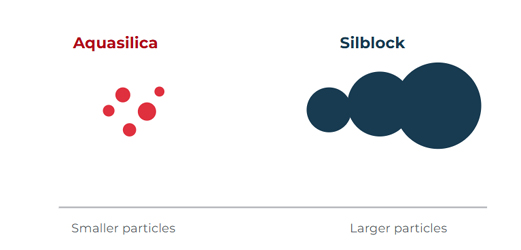
Schematic comparison of colloidal nanoscale silica with larger micro-silica particles, not measured size distributions
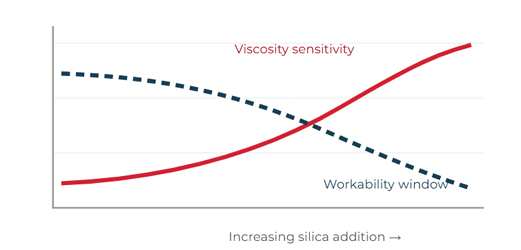
Qualitative schematic: changing silica loading can affect slurry viscosity and formulation workability; no product performance results shown
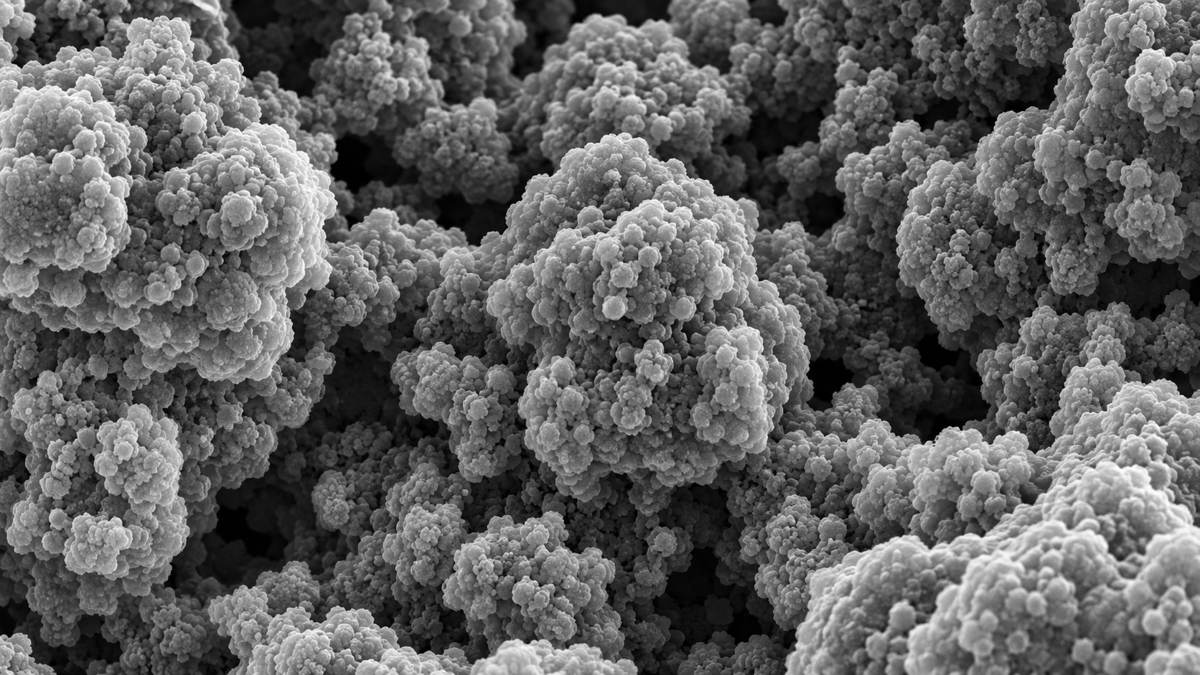
Silica may form fine primary particles and larger clusters. Dispersion, solids concentration and compatibility with the cement system govern how a grade behaves in practice. Request actual SEM and particle-size data for the grade under evaluation.
ASK FOR GRADE DATA ↗Technical guidance for understanding Silblock, Aquasilica, compatibility, formulation and laboratory evaluation.
Both are silica technologies, but micro-silica is handled as a fine solid or high-solids slurry, while colloidal silica is supplied as an aqueous dispersion. Use the approved grade TDS for the exact form.
The pictured flask illustrates a transparent colloidal silica dispersion. Appearance varies with concentration and particle size; confirm the actual supplied grade.
Screen it with the actual cement, mix water, dispersant and job conditions. Compatibility and dosage vary by formulation.
Check rheology, thickening time, free fluid, sedimentation, compressive strength and any well-specific performance requirements.
No. They explain design considerations; product performance needs grade-specific laboratory data.
Both liquid product forms can be discussed for supply in sealed, pallet-mounted IBCs, subject to grade, batch, destination and confirmed availability.
Image is a representative logistics visualization. It does not document packed stock or confirm that a shipment is ready for dispatch.
CHECK IBC AVAILABILITY ↗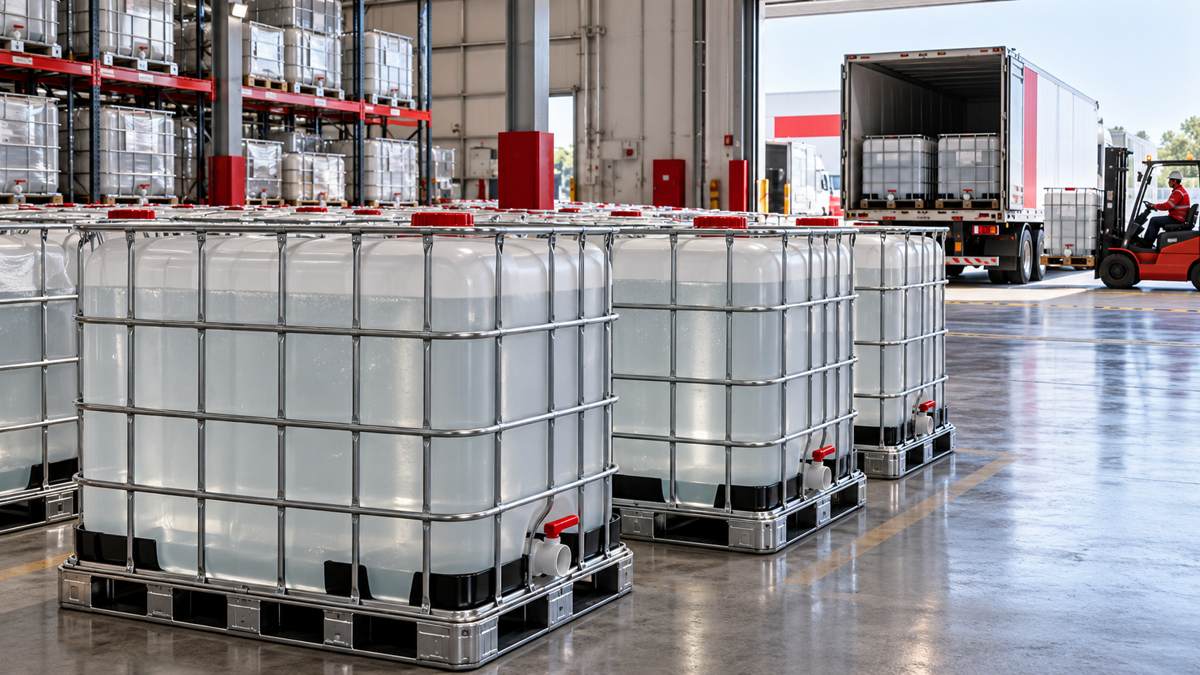
Send the cement type, water chemistry, target density, temperature and preferred silica form. Our technical team can help plan a screening program.
Contact EXPLORAX ↗