

EXPLORAX Oilfield Chemical Technology
OIL & GAS • SURFACE & INTERFACE CHEMISTRY
Wetting Agents

High-performance wetting chemistry for Drilling, Cementing, Stimulation and Completion systems — designed to improve liquid-to-solid contact, powder wet-out, spreading, penetration and interface control across demanding oilfield formulations.

From contact angle to field performance

WETTING THAT FITS THE JOB.

Oilfield wetting-agent selection should start with the job function, not only the surfactant label. The practical requirement may be faster powder incorporation during drilling-fluid make-up, improved liquid-solid interaction in cement and spacer support systems, better spreading in stimulation treatments, or controlled wetting in completion brines and additive packages.

Application-first screening

Evaluate substrate, water or hydrocarbon phase, salinity, temperature, other surfactants, foaming sensitivity and the desired wetting outcome before selecting chemistry.

Scalable Commercial Agility

100%, 50%, 35%, 20% and 10% active grades allow concentrated formulations, easier dosing, simpler pre-blending and field-side handling.

WHERE WETTING AGENTS ARE USED

FOUR OILFIELD APPLICATION STAGES.

Each stage uses wetting chemistry for a different reason. The selection should therefore be matched to the process, fluid and surface the chemistry actually encounters.

Oilfield drilling image with pumpjack and wellhead equipment
01 / DRILLING

Drilling

Supports rapid liquid contact with powders and particulate additives during mud preparation. Wetting chemistry can improve powder take-up, reduce stubborn dry pockets and assist more uniform incorporation of specialty solids into the working fluid.


Powder wet-out Fluid make-up Solids contact Mixing support
Oilfield surface tanks and chemical handling equipment
02 / CEMENTING

Cementing

Evaluated in spacer and cement-support packages where liquid-solid interaction, controlled spreading and additive distribution are important. Selection must also consider foam generation, ionic compatibility and the sensitivity of cement-system rheology.

Spacer systems Slurry support Controlled wetting Foam balance
High-pressure stimulation pumping trucks and fluid-transfer lines
03 / STIMULATION

Stimulation

Used where treatment-fluid contact and penetration are important. Better wetting can increase surface coverage and fluid access to difficult rock or residue surfaces, subject to compatibility with breakers, friction reducers, salts and other stimulation additives.

Surface coverage Penetration Formation contact Additive compatibility
Completion and production operator standing among blue process pipelines
04 / COMPLETION

Completion

Supports clean, controlled wetting in completion-fluid and brine packages where predictable interface behavior is required. Chemistry choice should be screened against brine salinity, multivalent ions, foaming profile and the rest of the completion additive package.

Brine compatibility Clean wetting Interface control Predictable response
CHEMISTRIES OFFERED

SIX WETTING PLATFORMS.

A structured product family covering silicone, fluorinated, hybrid, polymeric, EO/PO and bio-based routes. Each chemistry gives a different balance of spreading power, compatibility, foam behavior and handling.

Oilfield chemical processing equipment and storage drums
01 / SILICONE
SUPER-SPREADING CHEMISTRY

SURFITON
SILWET

Silicone wetting platform for rapid spreading and strong dynamic wetting where low-dose efficiency is important.

Grades: SW-100 100% active · SW-50 50% · SW-20 20%
FAST SPREAD LOW DOSAGE DYNAMIC WETTING
03 / FLUOROSILICONE
HYBRID PREMIUM WETTING

SURFITON
FS-10

Fluorosilicone hybrid designed for specialty cases needing a premium balance of flow, spreading and interface response.

Grade: FS-10 10% active
HYBRID PREMIUM SPECIALTY
04 / POLYMERIC
ESTER-BASED POLYMERIC

SURFITON
POLYEST

Controlled wetting platform for applications where compatibility and a milder surface-active profile are preferred.

Grade: PE-35 35% active
ESTER BASED CONTROLLED WETTING COMPATIBILITY
05 / EO / PO
BLOCK-COPOLYMER WETTING

SURFITON
EOPROWET

Balanced non-ionic EO/PO chemistry with multiple active-level options for versatile oilfield formulation use.

Grades: EP-100 100% · EP-50 50% · EP-20 20%
NON-IONIC BALANCED PROCESS FRIENDLY
06 / BIO-BASED
RENEWABLE-DERIVED WETTING

SURFITON
BIOWET

Development platform for customers investigating renewable-derived wetting chemistry while retaining application-performance discipline.

Platform: BW-40 bio-based blend concept
RENEWABLE EMERGING SUSTAINABILITY
WETTING EFFECT

FROM BEADING TO SPREADING.

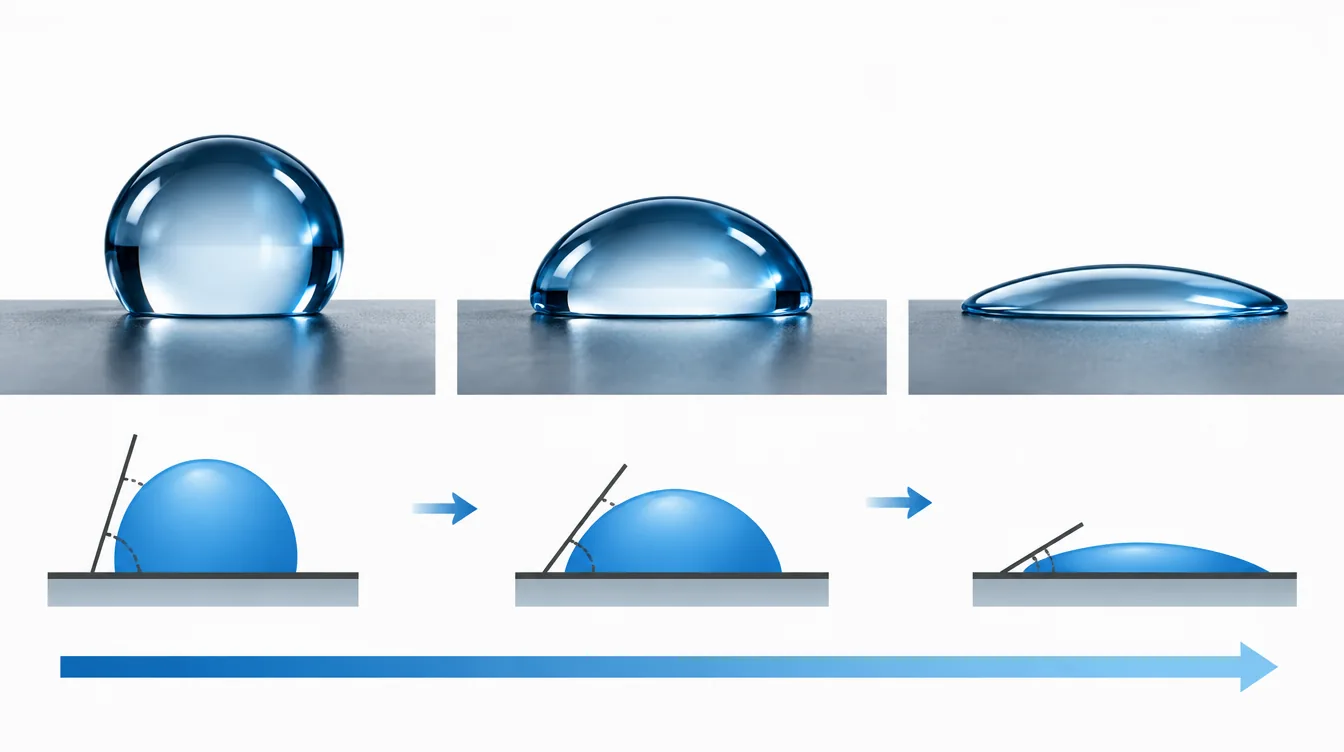
A wetting agent reduces the resistance between a liquid and the target surface. As the contact angle drops, the droplet spreads over a larger area and the fluid gains better access to the solid or surface it needs to treat.

In oilfield systems, the useful outcome may be faster powder wet-out, more uniform surface coverage, stronger substrate contact or improved penetration — depending on the formulation and job stage.

Technical visualization of liquid droplet beading and improved wetting on a surface
Technical visualization: poor wetting → improved wetting → strong spreading.
Contact-angle illustration showing droplet spreading and surface coverage
Contact-angle concept: lower angle generally means greater surface coverage.

Wetting performance should be measured in the actual fluid/substrate system because salinity, solvents, other surfactants, temperature and contamination can materially change the observed response.

GRADE REFERENCE

PRODUCT REFERENCE.

A practical comparison of the current proposed EXPLORAX wetting-agent grade architecture. Final dosage and grade choice should be validated against the real formulation.

01

SURFITON SILWET SW-100

100% active
SILICONE

Concentrated super-wetting route for maximum potency and low-dose formulation design.

02

SURFITON SILWET SW-50

50% active
SILICONE

Mid-active silicone grade for easier incorporation and metering.

03

SURFITON SILWET SW-20

20% active
SILICONE

Lower-active option for controlled dosing and simple handling.

04

SURFITON FLUROWET FW-N100

100% non-ionic
FLUOROSURFACTANT

High-efficiency route where very low surface tension and difficult wet-out are required.

05

SURFITON FLUROWET FW-A20

20% anionic
FLUOROSURFACTANT

Anionic fluorinated option for selected charged formulation systems.

06

SURFITON FS-10

10% active
FLUOROSILICONE

Premium hybrid route for specialty wetting and flow requirements.

07

SURFITON POLYEST PE-35

35% active
POLYMERIC

Ester-based polymeric wetting for controlled performance and compatibility-led selection.

08

SURFITON EOPROWET EP-100

100% active
EO / PO

Full-active non-ionic route for concentrated EO/PO-based systems.

09

SURFITON EOPROWET EP-50

50% active
EO / PO

Balanced active level for general industrial formulation use.

10

SURFITON EOPROWET EP-20

20% active
EO / PO

Lower-active EO/PO option for easier handling and dosing control.

11

SURFITON BIOWET BW-40

Bio-based blend
BIO-BASED

Renewable-derived development concept for sustainability-led projects.

BIO-BASED PLATFORM

BIOWET FOR NEXT- GENERATION OILFIELD FORMULATION.

SURFITON BIOWET is positioned as a development platform for customers looking to evaluate renewable-derived or partially bio-based wetting chemistry. It should still be held to the same technical standards as conventional products — wetting efficiency, brine compatibility, temperature response, foam tendency and formulation stability.

01

Renewable-derived direction

Supports sustainability discussions without making performance secondary.

02

Application screening

Best evaluated against drilling, cementing, stimulation or completion systems individually.

03

Compatibility first

Brines, salts, solvents and other surfactants can strongly affect the observed result.

04

Development platform

Suitable for co-development rather than assuming universal interchangeability.

Industrial chemical handling and oilfield formulation equipment
SURFITON / BIOWET BW-40
TECHNICAL PARTNERSHIP

SCREEN. MATCH. OPTIMIZE.

Oilfield wetting-agent performance depends on far more than the surfactant family. We recommend side-by-side screening against the actual fluid system, substrate, salinity, other additives and the desired process outcome.

Contact-Angle Screening

Compare droplet behavior and wet-out on the real target substrate.

Compatibility Testing

Check fit with brines, solvents, polymers, defoamers and other surfactants.

Foam / Side-Effect Balance

Measure wetting improvement together with foam tendency, separation or haze.

Concentration Selection

Choose the most practical active level for plant or field-side dosing.

Technical partnership and oilfield application
WETTING AGENT FAQ

WETTING
AGENT
FAQ.

General guidance for selecting oilfield wetting agents. Final product selection should be based on fluid chemistry, substrate, salinity, compatibility and the required performance target.

Silicone grades are often screened for fast spreading and low-dose efficiency, while fluorosurfactants are considered when stronger surface-tension reduction or very difficult wet-out is required. Compatibility and foam behavior should decide the final choice.

They can improve liquid contact with powders and particulate additives, helping reduce slow wet-out or dry pockets during fluid make-up. This should be confirmed in the actual mixing sequence.

Yes, in selected support formulations they can improve liquid-solid interaction and spreading. Cement systems can be sensitive to foam and rheology changes, so laboratory compatibility screening is important.

They are evaluated where better surface coverage, contact or penetration can improve the treatment-fluid interaction with the target surface or residue. They must remain compatible with the rest of the stimulation additive package.

Brine compatibility, clean interface behavior, low unwanted foam and stable response in the presence of multivalent ions are key screening considerations.

No. Wetting agents improve wet-out and spreading; defoamers are selected to destabilize or suppress foam. Some chemistries can influence both behaviors, but they serve different primary functions.

Different active levels give flexibility in dosing, viscosity, freight efficiency and ease of incorporation. The best format depends on the customer formulation and plant or field handling method.

Yes. Some surface-active chemistries can increase or stabilize foam, so wetting gain and foam behavior should be measured together.

Useful methods include contact-angle observation, spreading comparison, time-to-wet tests, powder incorporation trials and side-by-side evaluation in the actual formulation.

No. Bio-based chemistry should be evaluated on the same performance criteria as conventional grades. Sustainability is valuable, but wetting efficiency, stability and compatibility remain essential.

NEED THE RIGHT WETTING CHEMISTRY?