

A latex polymer platform for oilwell cement systems, designed for screening where slurry fluid loss, early gas flow and cement sheath integrity are critical to the job.
Help the cement barrier form without gas channels.
As cement slurry transitions from a pumpable fluid to a solid barrier, formation gas may enter if hydrostatic pressure declines before the slurry develops sufficient resistance. A suitable latex package can be evaluated with fluid-loss control and other additives to support a more robust transition.
EXPLORAX Oilfield Latex is a family concept. The formulation must be selected and tested with the actual cement, mix water, salts, dispersant, retarder and anticipated temperature and pressure schedule.

Application-lab visualization; the photograph does not show a measured performance result.
Gas migration control
Screen as part of a cementing package intended to limit early gas flow through the slurry.
Fluid-loss support
Evaluate latex contribution alongside the job's fluid-loss-control components.
System compatibility
Compare rheology, thickening time and stability with the complete slurry formulation.
How the latex route is evaluated.
Gas migration is a whole-slurry problem. Latex is screened with the cement, water and companion additives for a continuous, stable slurry and a controlled transition toward set.
Disperse in the mix
Confirm the emulsion remains compatible with the mix water and cement chemistry.
Control filtration
Evaluate fluid loss and the response of the filter cake under the relevant test conditions.
Check the transition
Assess static gel strength development, thickening time and gas-flow potential with the final slurry.
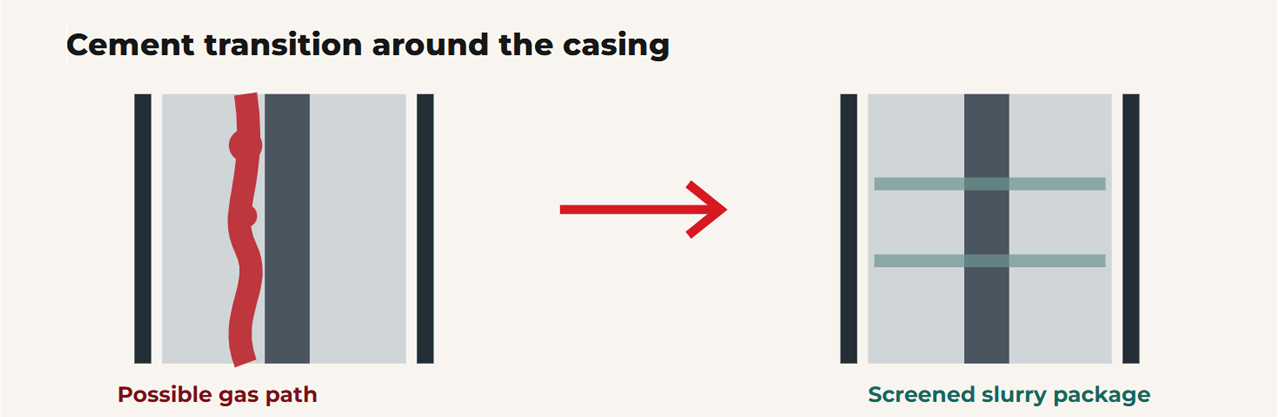
Illustrative mechanism only. The drawing does not represent a measured result or guarantee gas-migration prevention.
Three GEPEX latex routes.
Choose a grade by the fluid system and well conditions, then validate performance with the complete field formulation.
GEPEX D-100
Latex for drilling-fluid formulation
A candidate polymer dispersion for drilling-fluid screening where fluid-loss behavior, emulsion stability and compatibility with the base fluid matter.
GEPEX C-200
Latex for gas migration control
Designed for evaluation in cement slurries where fluid-loss control and the transition to an effective gas barrier are priorities.
GEPEX HT-300
Latex for elevated-temperature cementing
A high-temperature screening route for cement systems exposed to demanding placement and curing schedules; verify stability and slurry response at the planned temperature.
Screen for the well's full heat schedule.
A high-temperature latex candidate must remain stable during mixing and placement and support the target cement properties after thermal conditioning. The actual limits depend on the complete slurry system.

Temperature response: a screening map
Use laboratory measurements to compare each GEPEX formulation at the expected circulating and static temperatures.
- Inspect latex dispersion stability in mix water and brine after heat conditioning.
- Measure slurry rheology, fluid loss and thickening time at the planned placement schedule.
- Check transition behavior, gas-flow potential and set-cement performance where relevant.
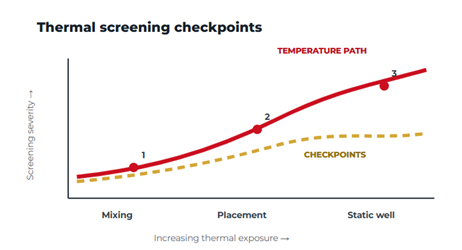
Four points in the cementing workflow.
Primary cement slurry
Screen in Class G/H or blended cement formulations where fluid loss and gas migration are design concerns.
Fresh water or brine
Check emulsion stability and cement response with the actual mix-water chemistry.
Pumpability window
Confirm rheology and thickening time at the expected circulation and temperature schedule.
Early gas-flow risk
Evaluate static gel strength and gas-flow potential while the slurry develops a barrier.
Technical data and screening.
The table defines what a grade specification and application study should report. Numerical values will be added only after an approved grade TDS and measured test results are available.
| PROPERTY | PUBLICATION STATUS | WHY IT MATTERS |
|---|---|---|
| Product chemistry | Oilfield latex polymer dispersion; exact grade chemistry to be confirmed | Compatibility and handling |
| Appearance and active solids | Grade-specific TDS required | Dosage on active basis |
| pH, density and viscosity | Grade-specific TDS required | Mixing, pumping and storage |
| Recommended dosage | Set by slurry design and laboratory screening | Use the final cement and water |
| Fluid loss and rheology | Measure at target temperature and pressure | Placement and filtration response |
| Thickening time and free fluid | Measure in final slurry | Operational window and stability |
| Static gel strength and gas-flow potential | Measure in job-specific tests | Gas migration evaluation |
| Packaging and shelf life | Confirm with final commercial grade | Logistics and storage |
Illustrative screening sequence
Conceptual screening sequence from baseline slurry through latex dose series to validated field design
How to evaluate and use.
Collect the actual materials
Use the job cement, mix water and planned dispersant, retarder, defoamer and spacer contaminants.
Check addition order
Confirm mixing sequence, shear and emulsion stability in the laboratory before field batching.
Run the cement program
Measure fluid loss, free fluid, rheology, thickening time, static gel strength and gas-flow tendency.
Use approved parameters
Apply the validated dose and handling instructions for the specific grade and cement design.
Oilfield Latex FAQ.
Technical guidance for understanding oilfield latex, cementing applications, gas migration control, fluid-loss performance, compatibility and laboratory evaluation.
It is screened as part of a cement slurry package where gas migration and fluid-loss control are concerns. The full slurry must be validated for the well.
No. Gas-flow control depends on the complete slurry design, placement, fluid loss and the transition to set. Laboratory evaluation is required.
It may be screened with either cement type, but compatibility and performance must be measured using the actual cement and additives.
No universal dose applies. Establish a dose series in the job-specific slurry and choose the validated concentration.
Salts can alter emulsion stability and slurry response. Test the product in the actual fresh water or brine before use.
It may affect the complete formulation. Thickening time and rheology should be measured with all planned additives at the relevant schedule.
Fluid loss, free fluid, static gel strength development and gas-flow potential are among the key screening tests, alongside routine slurry performance checks.
Selected latex chemistries may be evaluated for drilling applications, but this cementing page does not establish drilling-fluid suitability for a specific grade.
No. It is a publication checklist. Approved numerical specifications require a final grade TDS and quality-control method.
Share cement type, slurry density, water chemistry, temperature and pressure schedule, additive package, placement time and gas migration target.
Ready for site logistics.
GEPEX latex grades can be planned for bulk handling in IBC totes or palletized drums, subject to the confirmed grade, pack size and shipment plan.
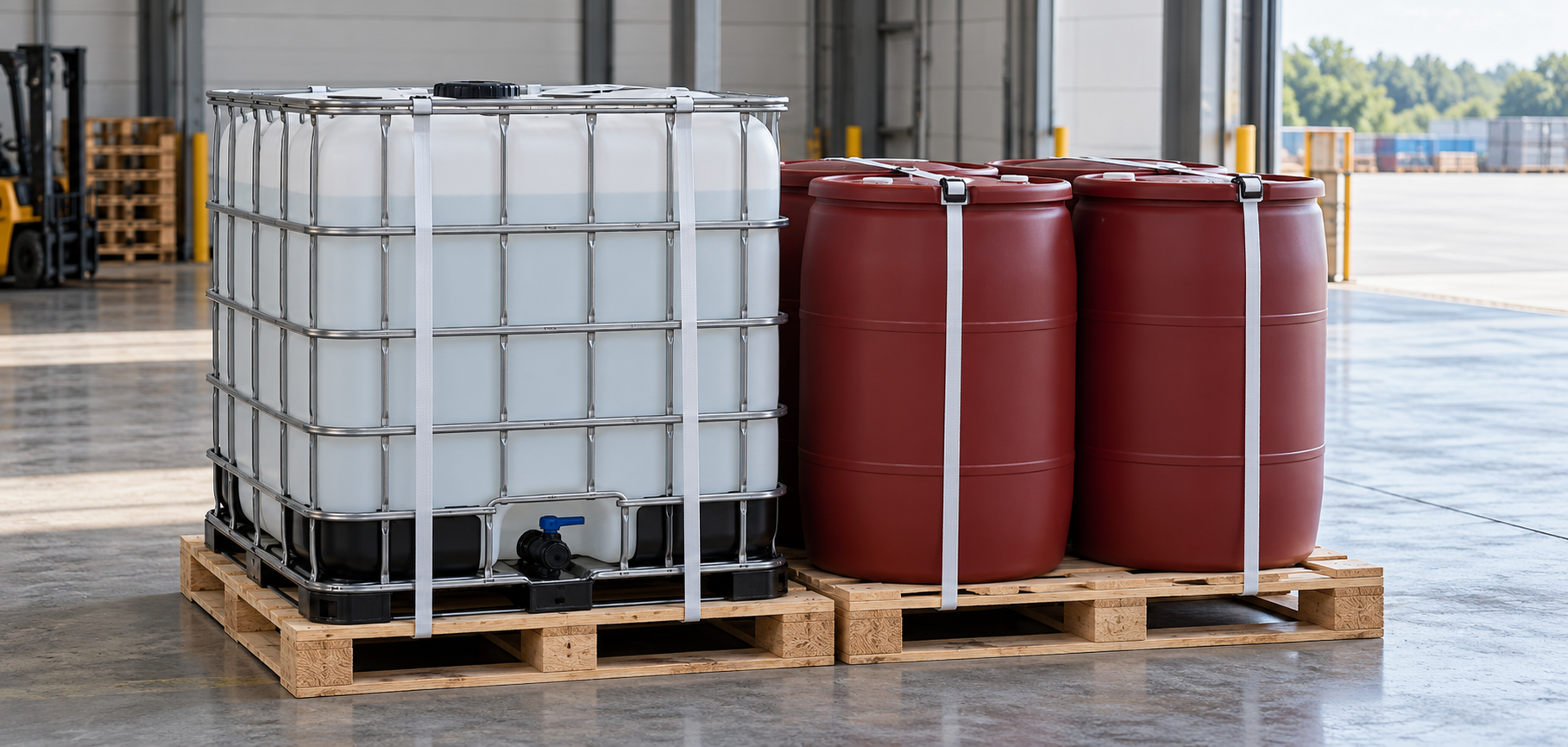
Illustrative packaging image. Final packaging, fill weight and labeling are confirmed on quotation and approved documents.
IBC totes
For larger volume handling where a contained, pumpable supply format is preferred.
Drums on pallets
For smaller lots, staged trials and convenient warehouse or site distribution.
Find your FOAMSTAB grade.
Share your fluid composition, brine, temperature, mixing conditions and foam-control target. Our team can suggest grades for comparative testing.
Contact EXPLORAX ↗