EXPLORAX H2S-40
40% Standard Active Grade
A lower-active MEA-triazine option suited to applications where easier dilution, handling flexibility or staged treatment is preferred.

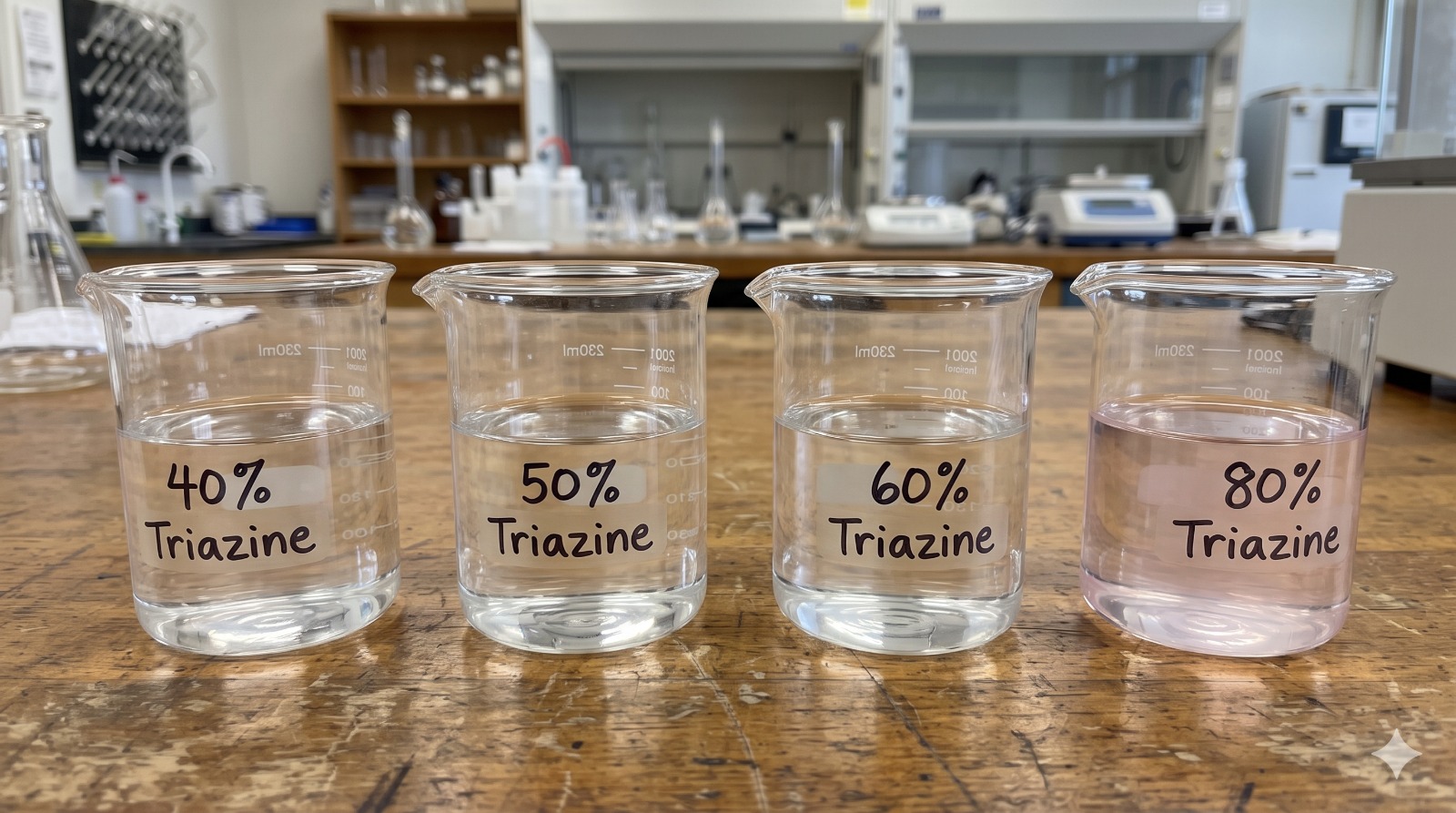
High-performance MEA-triazine scavenger solutions for hydrogen sulphide control in upstream production, hydrocarbon processing and associated treatment systems. Available in 40%, 50%, 60% and high-active 80% grade options to match treatment demand, handling preference and logistics strategy.
EXPLORAX MEA Triazine grades are aqueous hydrogen sulphide scavenger solutions designed for direct chemical treatment of sour gas, liquid hydrocarbon and process streams. The product family gives formulators and field teams flexibility to choose a concentration aligned with H₂S loading, injection route, storage and pumping constraints, fluid compatibility, target residual H₂S and the economics of transport and treatment.
Rather than treating concentration as the only selection criterion, EXPLORAX recommends reviewing the complete operating envelope: gas or liquid phase, H₂S concentration, contact time, water cut, hydrocarbon composition, temperature, pressure, injection location, mixing efficiency and downstream handling. This allows the active strength and dosage program to be matched to the actual field condition.
Choose the active strength around H₂S load, fluid phase, treatment point, pumping characteristics and logistics rather than simply choosing the highest concentration.
Support from laboratory screening and dosage estimation through IBC supply, batch QA documentation and commercial delivery planning.
The recommended grade depends on treatment duty, fluid handling, storage, pumpability and total delivered treatment economics. Final selection should be validated in the intended system.
A lower-active MEA-triazine option suited to applications where easier dilution, handling flexibility or staged treatment is preferred.
A mid-range concentration balancing active content, field handling and transport efficiency for a wide range of sour-stream treatment programs.
Higher active content for customers looking to reduce transported water and increase active chemical delivered per package. Typical viscosity target: 30–80 cP.
High-active concept for specialized treatment and logistics programs where concentrated supply is preferred. Availability and handling parameters should be confirmed before qualification.
The best grade is the one that gives the required H₂S reduction with practical pumping, contact, storage and logistics—not necessarily the highest active concentration.
MEA-triazine scavengers can be deployed in multiple upstream and hydrocarbon-handling locations. The optimum treatment point depends on phase behavior, contact efficiency and the required downstream H₂S specification.
Direct chemical treatment of H₂S-containing gas streams where sufficient gas–liquid contact can be established.
Use in liquid hydrocarbon and production-fluid treatment programs after checking mixing, water phase, emulsion and downstream compatibility.
H₂S mitigation in storage and transfer operations where sour vapors or liquid-phase H₂S can create safety and handling concerns.
Potential use in compatible process and fuel-oil treatment programs where H₂S reduction is required before storage, transfer or downstream handling.
MEA-triazine functions by chemically reacting with hydrogen sulphide when adequate contact is created between the scavenger solution and the sour stream. Field performance depends on more than active concentration: dispersion, residence time, injection point, temperature, H₂S loading and fluid composition all influence utilization.
Establish H₂S concentration, phase, flow rate, temperature, pressure, water cut, hydrocarbon composition and the required outlet specification.
Choose 40 / 50 / 60 / 80% active strength and a treatment point that provides practical pumping, good mixing and sufficient contact time.
Estimate dosage from the measured H₂S load, then confirm by laboratory or field response rather than relying on a universal ppm treatment rate.
Track inlet/outlet H₂S, chemical rate, process stability and downstream effects; adjust concentration or injection strategy as operating conditions change.
Representative product-family information for website use. Final release specifications should be taken from the applicable TDS and batch COA.
MEA-triazine based H₂S scavenger solution
40%, 50%, 60% and 80% active-strength options
30–80 cP
Hydrogen sulphide scavenging / sour-stream treatment
Upstream production, hydrocarbon handling, fuel-oil/process treatment, tanks and transfer systems
2933 69 90
IBC / tote supply; bulk or alternate packaging subject to commercial program
Approx. 18 totes per 20 ft container, subject to tote specification and shipping limits
Important: website values are indicative and intended for grade selection. Density, pH, viscosity, active matter, storage temperature and other release parameters should be confirmed against the current TDS / COA for the specific grade.
Final grade and dosage depend on the actual sour stream. These FAQs are intended to help structure the technical discussion before laboratory or field qualification.
Selection should consider H₂S loading, gas/liquid phase, contact time, pumpability, storage and shipping economics. Higher active content can reduce transported water, but the most concentrated grade is not automatically the best choice for every injection system.
Begin with the measured H₂S load and total stream flow, then apply a practical treatment factor based on contact efficiency and system conditions. The starting estimate should be verified by lab or field response and adjusted to the required outlet H₂S level.
It can be evaluated in both types of systems, but phase contact and mixing are critical. Liquid systems should also be checked for water cut, emulsion tendency and downstream compatibility.
Please provide inlet H₂S, target outlet H₂S, gas or liquid flow rate, temperature, pressure, water content/water cut, hydrocarbon type, injection point, contact time and current chemical dosage if an incumbent product is being used.
60% is a high-active commercial option that can deliver more active scavenger per package. Pumpability, storage temperature and injection equipment should still be checked against the specific product specification.
It is positioned as a very high-active option for specialized programs. Because higher concentration can materially affect physical handling characteristics, availability, viscosity, pumping and storage conditions should be confirmed before qualification.
Yes. Provide the incumbent TDS/SDS, active content, current dosage, inlet/outlet H₂S and process conditions. A comparison can then focus on actual treatment performance and delivered chemical economics.
IBC/tote packing is suitable for many commercial programs. Bulk or alternate packaging can be discussed for larger recurring volumes. Export loading depends on tote dimensions, gross weight and shipping restrictions.
Yes, applicable technical and safety documentation can be provided for the confirmed grade, together with batch COA for commercial supply.
Yes. The most useful optimization data are inlet/outlet H₂S, chemical rate, process changes, temperature and flow. This allows the dosage or grade concentration to be adjusted around actual operating performance.
Send the sour-stream conditions, H₂S concentration, flow rate and target outlet specification. We can help shortlist the appropriate EXPLORAX MEA-triazine concentration for evaluation.
START A TECHNICAL DISCUSSION ↗