

EXPLORAX SP-182P is a polysaccharide-based polymer concept for engineered spacer systems used between drilling fluid and cement slurry.
A polymer
platform for
spacer design.
A cementing spacer must fit the fluid system, displacement sequence and pumping window. SP-182P offers a polysaccharide-based polymer route for tuning spacer rheology in a complete formulation. Its performance depends on the surfactant package, solids, density, brine and contact with the actual mud and cement slurry.
Where the spacer sits in the sequence.
The spacer is pumped between drilling fluid and cement slurry. A successful formulation is qualified against the actual mud and cement, with attention to rheology, compatibility, stability and operational displacement conditions.
Drilling fluid
Characterize the mud composition, density, rheology and conditioning needs.
Engineered spacer
Use SP-182P as part of a polysaccharide-based spacer formulation and screen the full additive package.
Cement slurry
Test interfaces and placement conditions with the actual slurry design.
Separate, condition, displace.
The diagram shows the role of a spacer in the pumping sequence. It is a conceptual illustration rather than field performance data.
DRILLING FLUID
Fluid to be displaced
SP-182P SPACER
Polysaccharide polymer platform
CEMENT SLURRY
Placement fluid
SP-182P at a glance.
A red-brown polysaccharide spacer polymer for building suspension and controlled flow in cementing spacers. The values below are indicative development results and application targets, drawn from the related EXPLORAX SPACER BIO-330 development TDS. BIO-330 is a formulated polysaccharide/sulfonated-polymer blend; its results arenot measured SP-182P results.
| PROPERTY | INDICATIVE RESULT / TARGET | APPLICATION MEANING |
|---|---|---|
| Appearance | Red-brown, free-flowing powder | Easy identification and dry blending |
| Chemical type of BIO-330 reference | High-MW polysaccharide / sulfonated polymer blend | Formulated spacer additive; distinct from SP-182P polymer grade |
| Water behavior | Disperses and hydrates into a shear-thinning fluid | Supports solids suspension and pumpable flow |
| Recommended starting dosage | 3–5 lb/bbl (8.6–14.3 g/L) | Adjust to water, solids and temperature |
| Typical screening density | 10–18 ppg, with weighting agent | Set for the individual cementing job |
| Example test spacer | 13.0 ppg; 4 lb/bbl (11.4 g/L) additive | Fresh-water, barite-weighted development formulation |
| Apparent viscosity at 25 °C | 37.0 cP | Development example; Fann 600 rpm reading ÷ 2 |
| Apparent viscosity at 60 °C | 31.0 cP | Development example on the same formulation |
| Apparent viscosity at 80 °C | 28.0 cP | 76% of the 25 °C example |
| Apparent viscosity at 120 °C | 23.5 cP | 64% of the 25 °C example; thermal validation required |
| Development temperature range | Ambient to approximately 120 °C | Subject to laboratory validation at job conditions |
| Standard pack / provisional storage | 25 kg lined bag / up to 12 months dry | Confirm commercial pack and stability for SP-182P |
Spacer behavior from 25 to 120 °C.
Tentative BIO-330 development targets for a 13.0 ppg barite-weighted fresh-water spacer at 4 lb/bbl (11.4 g/L). Fann 35-type rotational readings. These values describe the formulated BIO-330 spacer example, not measured SP-182P powder or a completed SP-182P formulation.
| TEMPERATURE | 600 RPM | 300 RPM | APPARENT VISCOSITY | PV | YP | RETENTION |
|---|---|---|---|---|---|---|
| 25 °C / 77 °F | 74 | 48 | 37.0 cP | 26 cP | 22 lb/100 ft² | 100% |
| 40 °C / 104 °F | 69 | 45 | 34.5 cP | 24 cP | 21 lb/100 ft² | 93% |
| 60 °C / 140 °F | 62 | 41 | 31.0 cP | 21 cP | 20 lb/100 ft² | 84% |
| 80 °C / 176 °F | 56 | 37 | 28.0 cP | 19 cP | 18 lb/100 ft² | 76% |
| 100 °C / 212 °F | 51 | 34 | 25.5 cP | 17 cP | 17 lb/100 ft² | 69% |
| 120 °C / 248 °F | 47 | 31 | 23.5 cP | 16 cP | 15 lb/100 ft² | 64% |
Flow performance as temperature rises.
This development example shows apparent viscosity for a 13.0 ppg barite-weighted fresh-water BIO-330 spacer at 4 lb/bbl. It illustrates a useful spacer design window; SP-182P performance needs its own testing.
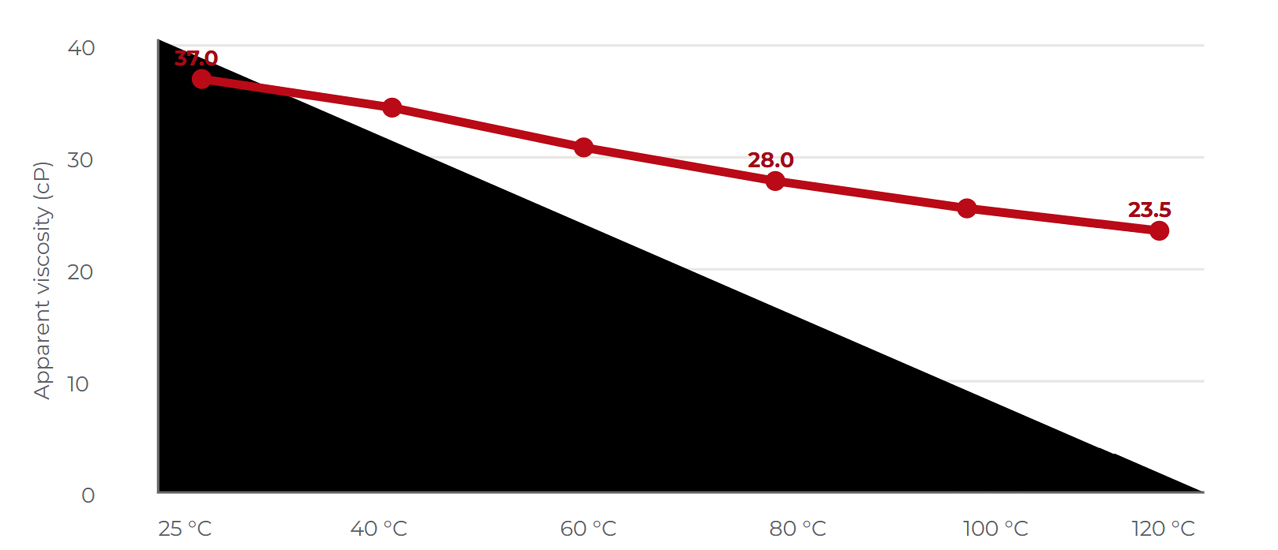
Source: supplied EXPLORAX SPACER BIO-330 development TDS, tentative Fann 35-type readings. Values are targets rather than laboratory observations and cannot be presented as SP-182P test results.
Designed for cleaner cementing
transitions.
Separate fluids
Place a spacer between drilling mud and cement slurry to reduce direct contact during displacement.
Carry weighting solids
Help keep barite suspended in a weighted spacer while the fluid is circulated through the well.
Manage flow
Build body at rest and retain pumpable flow during circulation. Adjust with the complete formulation.
Match the mud
For oil-based mud, add a separate oil-removal and water-wetting package; screen the final blend with actual field fluids.
FROM FLUID SAMPLES TO FIELD PROGRAMME.
Define
Collect well conditions, mud properties, cement design and placement constraints.
Screen
Select base-fluid, polymer, surfactant, weighting and foam-control options.
Test
Check compatibility, rheology, settling, mixability and conditioned performance.
Model
Set density, volume, rate and hydraulic programme around the annular system.
Validate
Confirm the final blend and field mixing sequence before operational release.
Choose the complete spacer for the
well.
Use these BIO-330 development guidelines when screening a proposed SP-182P spacer. Match the formulation to actual water, drilling fluid, weighting material and cement.
| FLUID / COMPONENT | PRACTICAL GUIDANCE |
|---|---|
| Fresh water | Suitable starting point for development; confirm performance with field water. |
| Seawater, NaCl or KCl brine | Potentially suitable; check hydration, dosage and spacer flow in the actual brine. |
| CaCl₂ or high-divalent brine | Test specifically, since divalent salts can alter polymer hydration and rheology. |
| Water-based mud | Combine with the appropriate surfactant and dispersant package; test mud displacement. |
| Oil- or synthetic-based mud | Add a separate oil-removal and water-wetting surfactant system; the polymer is not a complete oil-based mud wash. |
| API barite | Use to adjust density; verify dispersion and that solids do not settle. |
| Cement slurry | Check spacer contamination against the actual cement blend before field use. |
SP-182P FAQs.
Technical guidance for understanding SP-182P, spacer formulation, compatibility, dosage and laboratory evaluation.
It is a polysaccharide-based polymer concept for inclusion in engineered cementing spacer formulations. It is not a complete spacer recipe by itself.
It should be treated as a formulation component unless a complete qualified spacer blend is supplied for the specific job.
The polymer is considered when tuning rheology and fluid handling in a spacer placed between drilling fluid and cement slurry.
Compatibility must be determined with the actual mud. Spacer design for oil-based systems can require a different wetting and surfactant package.
Use 3–5 lb/bbl as an initial screening range based on the related BIO-330 spacer formulation, then set the SP-182P dosage with actual well fluids.
Check spacer rheology, stability, mud and cement compatibility, mixing behaviour and any job-specific displacement or contamination criteria.
No. Density is designed through the full liquid and solids package; the polymer is one component of the spacer system.
Test at the expected temperature and brine composition, including divalent ions where relevant, before setting the final formulation.
Email info@geoconproducts.com with mud and cement details, temperature, density targets, brine, pumping schedule and required test method.
LET’S DESIGN THE INTERFACE BEFORE THE JOB.
Contact the EXPLORAX Division of Geocon Group for cement-spacer formulation support, laboratory evaluation and international supply enquiries.
Contact EXPLORAX ↗